Much has been written this year about the 250th anniversary of the Declaration of Independence and much has been written during the past few decades, including full biographies, about the queer (at least, queer-adjacent) lives of three who served in George Washington’s Continental Army: Deborah Sampson, Casimir Pulaski, and Baron von Steuben. This piece provides a short biographical sketch of each of these revolutionaries, with additional resource links for those who want to learn more.
Deborah Sampson
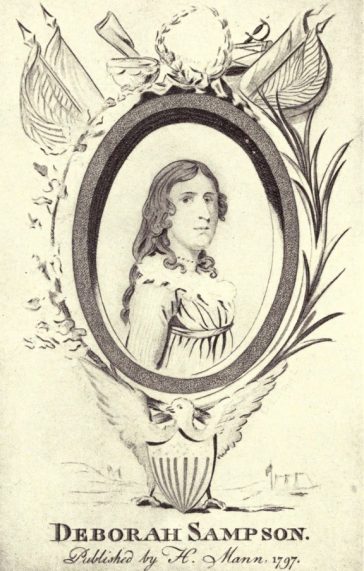
Frontispiece of The Female Review: Life of Deborah Sampson, the Female Soldier in the War of Revolution, published in 1797
Deborah Sampson was born in 1760 near Plymouth, Massachusetts, a descendent of Pilgrims. The only girl in a household of brothers, from early childhood she sought inclusion of her female self in the male-dominated world around her. Largely self-educated and by her twentieth year self-supporting, she served as a teacher and weaver (generally a male job at the time). But she wanted more – freedom from the limitations placed upon her assigned sex.
About a foot taller than the average woman of her day and well-toned from indentured servitude farm work, at age 22, in May 1782, she shorn off her locks of hair, bound her breasts, made a set of men’s clothing, and offered herself to the war effort against the British occupiers and home-grown Tories loyal to the Crown. She also left behind her birth name, exchanged for Robert Shurtliff, the name of an older brother who died before her birth.
She served for the duration of the Revolution, was shot in the thigh (treated it herself), and avoided discovery of her female frame until falling ill in an epidemic. She was honorably discharged at war’s end, returned to the world of women under her birthname, Deborah Sampson – likely, her only choice – and received a war pension, which passed to the husband she married in 1785 (with whom she had three children), after her death in 1827.
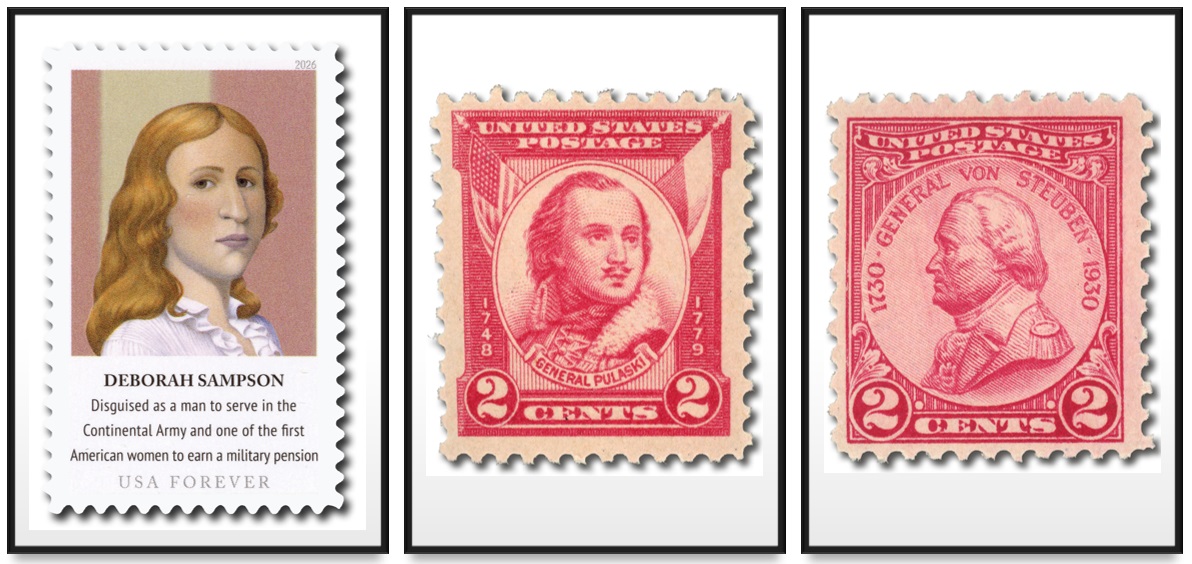
In 1989, a life-size statue of Deborah Sampson was dedicated on the grounds of the Sharon (Massachusetts) Public Library. Among those who spoke at the event was Sampson’s great-great-great granddaughter. In 1982, the state of Massachusetts established Deborah Sampson Day (May 23) and in 2023 the Deborah Sampson Award was founded, given annually to a female veteran. Sampson is among twenty-five selected in 2026 to appear on a USPS series of stamps honoring figures of the American Revolution.
TO LEARN MORE ABOUT DEBORAH SAMPSON:
America’s First Woman Warrior: The Courage of Deborah Sampson (Biography by Lucy Freeman and Alma Bond, 1992)
American Battlefield Trust: Deborah Sampson
National Women’s History Museum: Deborah Sampson
USPS Figures of the American Revolution series: Deborah Sampson
Casimir Pulaski
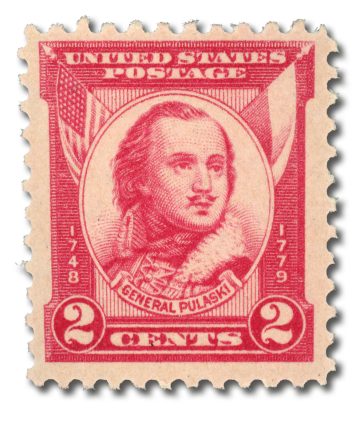
1931 U.S. Postal Service stamp
Casimir Pulaski was born into a Catholic family in Poland in 1745. He began his military career during his late teenage years and for the next decade and a half engaged in various military excursions as a cavalry commander, seeking unsuccessfully to maintain Poland’s independence from Russia. On the wrong side of that outcome, after the Partition of 1772, Pulaski was stripped of all honors inside Poland and forced to seek refuge outside of his native land, including in France where he met the American Benjamin Franklin, who was there seeking French support for the colonists’ war against King George III.
Franklin recommended Pulaski to General Washington and Pulaski traveled to North America in 1777. Washington appointed him general of the cavalry. Mortally wounded at the Siege of Savannah in 1779, he died – never married, no children – at 34. Fast forward 240 years to a detailed Smithsonian analysis of his bones that established as plausible a long-rumored assertion that Pulaski may have been intersex. (The fascinating Smithsonian documentary about this question is here.) These intersex claims remain unsettled and there are detractors. Either way, the contributions of the Father of the American Cavalry to the American War of Independence were substantial.
Pulaski was honored on a U.S. Postal Service stamp in 1931 and again in 1979. Since 1978, the state of Illinois has observed Casimir Pulaski Day on the first Monday of March. In 2005, a think tank devoted to Eastern and Central European issues was founded in Poland and named The Casimir Pulaski Foundation.
TO LEARN MORE ABOUT CASIMIR PULASKI:
BBC: “Casimir Pulaski May Have Been a Woman or Intersex, Study Says”
National Park Service: Casimir Pulaski
Smithsonian magazine: “Was the Revolutionary War Hero Casimir Pulaski Intersex?”
Smithsonian magazine: “Discover the Short Life and Long Legacy of Casimir Pulaski, a Polish Cavalry Officer Who Became an American Revolutionary War Hero”
Friedrich Wilhelm von Steuben
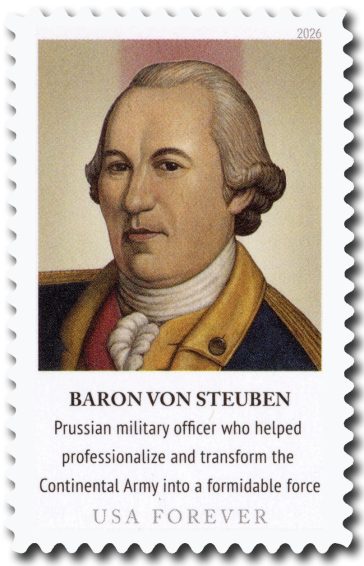
USPS Figures of the American Revolution stamp, 2026
More than thirty years ago, a small group of St. Louisans organized the short-lived Lambda Historical Society for the purpose of studying primarily local LGBTQ history. Among the public events we held were wreath-laying ceremonies at the Calvary Cemetery gravesite of Tennessee Williams and at the statue of Baron von Steuben in Tower Grove Park, marking the 200th anniversary of his 1794 death.
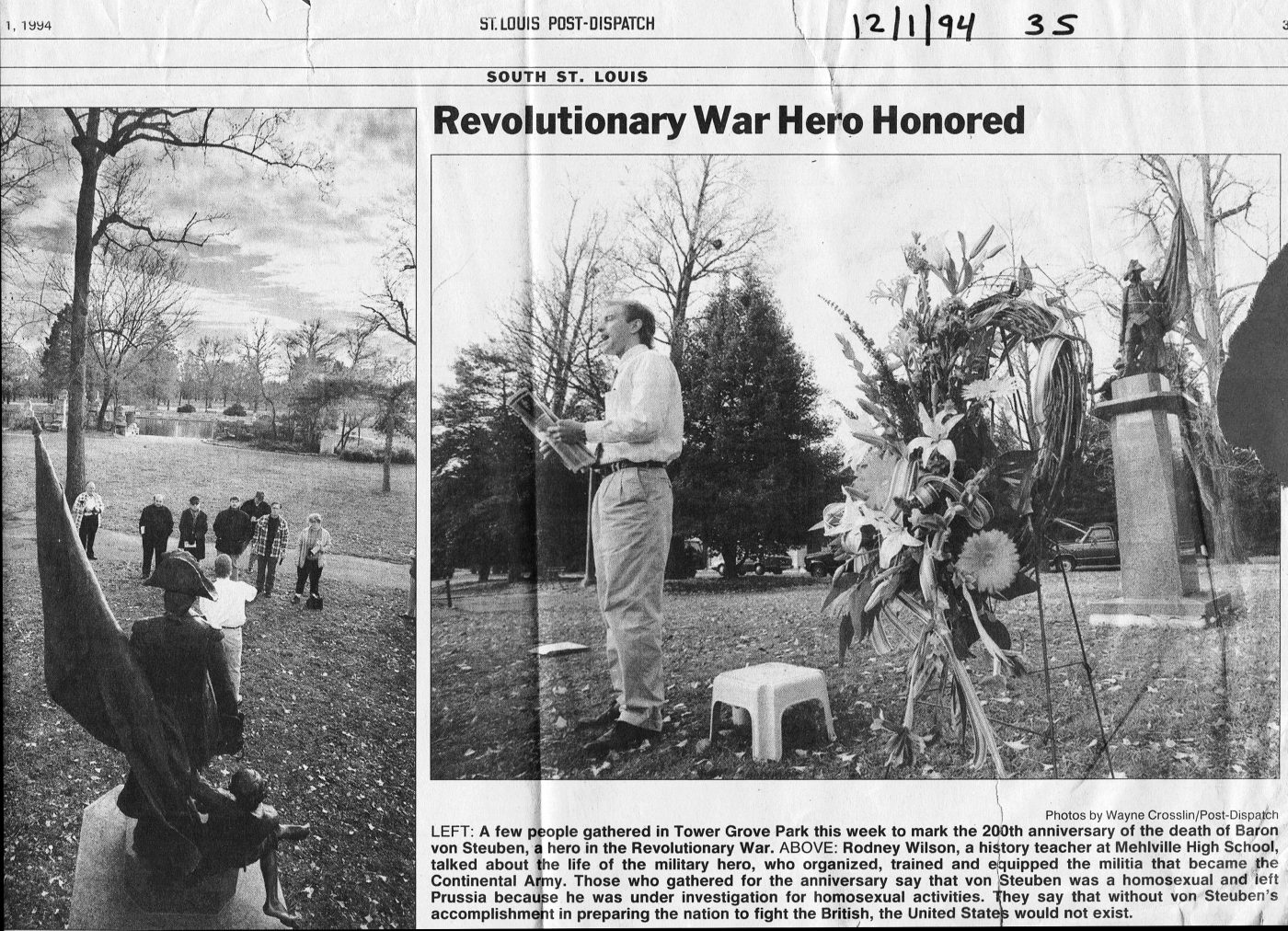
St. Louis Post-Dispatch, December 1994.
The Tennessee Williams ceremony didn’t cause a stir. The von Steuben event did: “The Steuben Society of America is appalled that homosexuals here have claimed Baron von Steuben as one of their own,” shouted the lead paragraph in a St. Louis Post-Dispatch article the following week.
One member of the St. Louis chapter of the Steuben Society of America even voiced concerns that “there’s a potential of those people infiltrating our chapter, and that’s distressing to many of our members.”
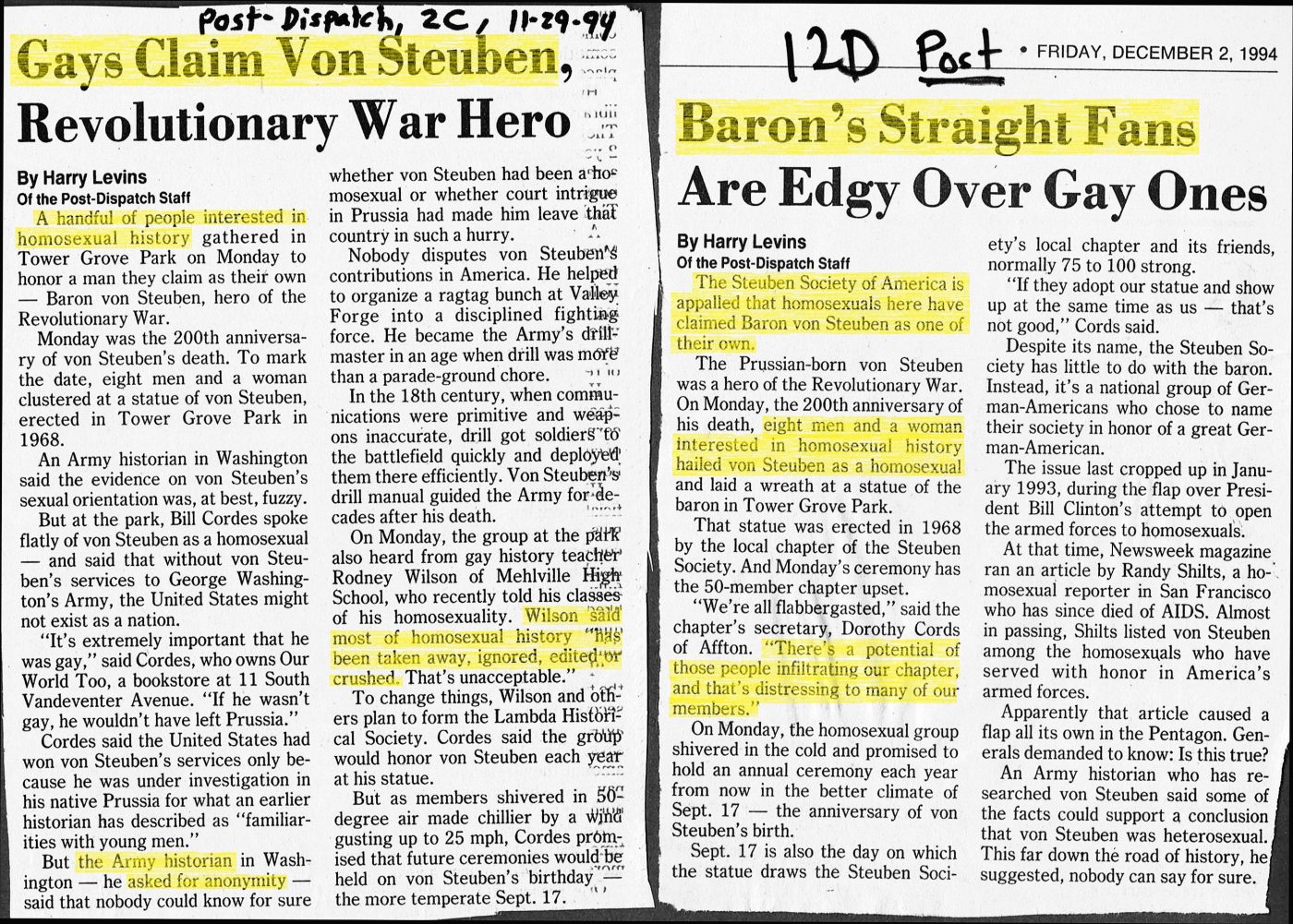
St. Louis Post-Dispatch, November 1994 and December 1994
Those people – of course! – were not interested in invading the local Steuben Society. Those people sought a simple acknowledgment that an immigrant hero of the American Revolution might have been – to use 2026 nomenclature – queer. Those people were asserting that LGBTQ history has been, as I stated at the time, “taken away, ignored, edited, or crushed.”
So who was this Prussian, so controversial even 200 years after his death?
Friedrich Wilhelm von Steuben was born in Prussia in 1730 and joined the impressive Prussian Army when he was a teenager. He excelled in military matters and for nearly 20 years served brilliantly, including as aide-de-camp to King Frederick. He gained the title baron in his early 40s by service to the German Hohenzollern principality.
Bored in a peaceful Europe, in the 1770s with the help of Benjamin Franklin, living in France as a recruiter for the colonial cause, he was recommended to Gen. George Washington. Washington named him Inspector General. Von Steuben brought Prussian discipline and order to the ragtag Colonial Army and rose to rank of major general and chief of staff to Washington.
Granted citizenship at the end of the successful war, von Steuben was granted an estate in New Jersey (confiscated from a former Loyalist to the crown) and later granted a second one in Upstate New York, along with an annual war pension. Never married, with no children, he was known his entire life to have special relationships with men. In his final years, he adopted two younger men who were recognized as legitimate heirs to his estate upon his death, which occurred in 1794.
During the fierce gays-in-the-military debate in the early 1990s, many LGBTQ activists claimed von Steuben as one of their own, an example of exemplary service to the United States by a homosexual person. There are several von Steuben statues across the nation, including the one in St. Louis’s Tower Grove Park (gifted to the U.S. by the German government during the 1904 World’s Fair) and since 1910 a 10-foot-tall bronze image standing atop a 15-foot granite base in Lafayette Park, across from the White House. The Revolutionary hero also has a county named after him: Steuben County, New York. In 1930, Von Steuben was honored with a USPS stamp and again this year, as one of twenty-five recognized in the Figures of the American Revolution Series.
TO LEARN MORE ABOUT BARON VON STEUBEN:
History Channel: “The Revolutionary War Hero Who Was Openly Gay”
LGBTQ Nation: “A Gay Immigrant Led the Country to Victory in the American Revolution” (Dr. Warren J. Blumenfeld essay)
National Park Service: General von Steuben
Smithsonian magazine: “The Prussian Nobleman Who Helped Save the American Revolution”
USPS Figures of the American Revolution series: Baron von Steuben
Rodney Wilson founded LGBTQ+ History Month in 1994. He teaches American history and world religions at a community college in Missouri.