For as long as I can remember, grounding myself in history has provided steady footing. Even an evening at a new restaurant requires a quick Google search to learn the who, what, when, where, and why of the establishment’s history.
In the period between 1990 and 1997 when I lived in St. Louis (South County, South City, West County), I was seeking a settled place of person and personality, particularly in regard to integrating being gay into being human. LGBTQ history was essential to that process and I used every opportunity during my graduate work at UMSL to explore LGBTQ history — international, national, and local. With each new fact came increased confidence and additional boldness about standing up for myself.
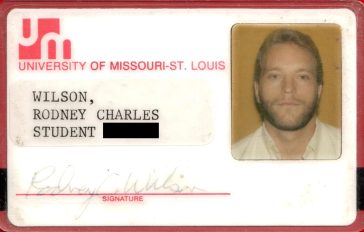
UMSL ID Card
In a 1995 course on post-1865 US history, I wrote a paper about the Central West End (CWE) and the role it played in LGBTQ life, a follow up about the geography of most of the spaces in the previous year’s paper, “‘The Seed Time of Gay Rights’: Rev. Carol Cureton, the Metropolitan Community Church, and Gay St. Louis, 1969-1980.”
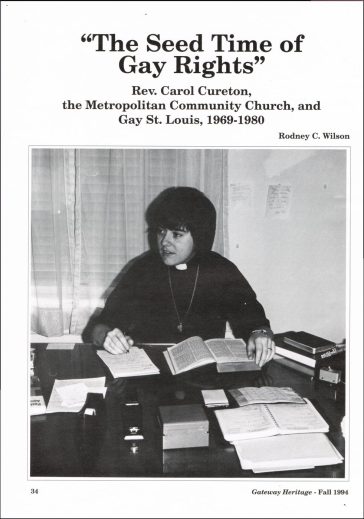
Title page of the article as it appeared in Gateway Heritage, a Missouri Historical Society publication, in Fall 1994.
The CWE in the 1990s, according to a 1994 St. Louis Post-Dispatch article, was “the Greenwich Village in St. Louis” — as close “to New York or San Francisco as you’re going to get in St. Louis.” My paper focused on LGBTQ liberty in that bright, shiny neighborhood, calling upon dozens of precious names and places from the period (in order of appearance):
Jeannette Batz, Laud Humphries, Pete Rothschild, Metropolitan Community Church, Lesbian and Gay News-Telegraph, Trinity Episcopal Church, The Loading Zone, Left Bank Books, Sunshine Inn, the Cathedral of St. Louis, T.S. Eliot, Tennessee Williams, Daniel Boone Expressway, Forest Park, Maryland Plaza, Gary Belis, Potpourri, Bottom of the Pot, Herbie’s, Mandrake Society, In Our 20s, Nuberry’s, Whites Organizing Against Racism (WOAR), Privacy Rights Education Project, Candace Gingrich, Rev. William Chapman, Amy Adams Squire Strongheart, KDHX, OutLook St. Louis, LesTalk, TWISL, Jim Thomas, Herbie’s, The Magic Wok, Balaban’s, Flowing Johnson, Take Back the Night, Judy Thursby, Adelaide and Herbie Carp, Brad L. Graham, Harold Austin, Carol Cureton, Mid-Continent Life Services Corporation, Washington University, Our World Too, Lisa Marie Neff, Growing American Youth (G.A.Y), The Complex, Attitudes, Umoja, and Rob Schwitz.
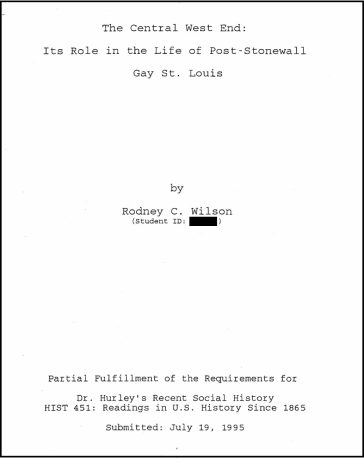
Unlike the Carol Cureton paper, the CWE one was never published. Only a handful have ever read it. Thinking that some might find it of a little interest and because I’d prefer the paper not be lost to time, I’m publishing it here. Do keep in mind, please, that this paper was written more than 30 years ago. It is not, therefore, as inclusive of language or scope as a paper written today would be. The term LGBTQ, for example, won’t be found in this paper. The word “queer” appears only one time, quoting a Left Bank Books’ advertisement: “33% Lesbian Owned; 100% Queer Friendly.” Additionally, my analysis is that of a young person only partially versed in the vitality of the entire community and the intersectional pressures of marginalized groups.
If memory serves, the paper earned a B mark. By today’s standards, it’s a C effort. I hope, still, that it’s a semi-adequate reminder of the historic role the Central West End has played in the liberalization of the St. Louis region. A click on the title page below will call up the PDF of the paper.
Rodney Wilson is the founder of LGBTQ+ History Month.