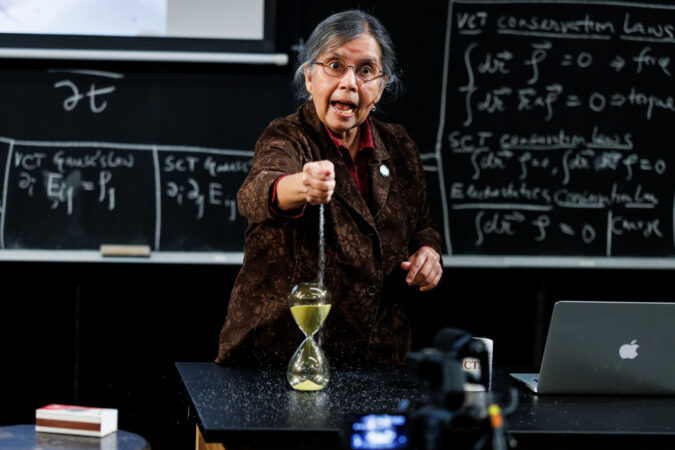
Rheology. Written and directed by Shayok Misha Chowdhury, in collaboration with Bulbul Chakraborty. A Bushwick Starr, HERE Arts Center, and Ma-Yi Theater Company production. At Playwrights Horizons’ Peter Jay Sharp Theater through May 29. Performed in Bangla and English. 90 minutes, no intermission.
As you find your seat, a woman with black hair streaked with silver stands at a whiteboard stretching the full width of the back wall, filling it with physics equations. You cannot tell whether this is a production assistant resetting the board or whether the play has already started. The house lights never change.
The play has already started. Bulbul Chakraborty, a theoretical physicist and the real-life mother of playwright Shayok Misha Chowdhury, turns from the board and lectures the audience on rheology, the study of how matter flows. Specifically, sand: why it pours through an hourglass like a liquid, then locks into a solid the moment it lands. A third of the audience leans in. Another third is figuring out the rules of the evening. The last third is wondering what they signed up for.
Then, mid-experiment, some dust seems to have gotten in her throat. Chakraborty coughs, and coughs again, and suddenly the evening breaks apart in a way I will not describe, because every audience deserves those seconds of genuine confusion. Chowdhury, a Pulitzer finalist for Public Obscenities, has built a theatrical framework around his mother’s research, with Krit Robinson’s set placing a sandbox, a blackboard, and an hourglass into a space that is simultaneously lecture hall, laboratory, and confessional. Mextly Couzin and Masha Tsimring’s lighting shifts register with the material, from the flat wash of a seminar room to something warmer and more exposed. George Crotty’s cello scores the transitions between modes. But the physics starts to feel less like the point and more like the permission structure that got two people into a room together.
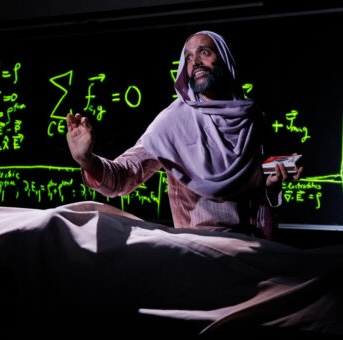 What Rheology is actually about is a son who cannot stop imagining his mother’s death. He and Chakraborty rehearse her dying in escalating registers. The Tagore-inflected sequences in Bangla, where Chowdhury climbs into bed beside his mother and sings until her hand drops, reach for a melodramatic gravity the production has not yet earned at that point in the evening. The staging goes still when it needs to escalate, and the emotional register of the Bangla text sits at a distance from an audience that has just been inside a physics lecture. But what does land, completely, is Bulbul Chakraborty on stage with her son. Not playing a mother. Being the mother. She is not a trained actor. She does not perform motherhood. She occupies it. The complicated dynamics between mother and son are familiar to the LGBTQ+ community, and Chowdhury, who is gay, brings that awareness to the stage without ever making it the subject. You can feel it in the negotiation itself, two people fighting for a closeness that is not guaranteed, trying to intellectualize a bond that resists the exercise.
Near the end, Chakraborty clicks to a photograph of her own mother’s body, received via WhatsApp while she was giving a talk. She speaks about missing the cremations of her mother, father, sister, and brother because she lives on the other side of the world. She weeps. A son’s fear of losing his mother meets a mother’s grief for her own mother, and the rheology falls away. What remains is two people in a room, trying to find the words before they run out of time. And then the punchline: Chakraborty tells her son he is fragile. She means it as a physicist. Fragile matter is not weak. It deforms under stress and rearranges itself. A mother telling her son he will survive her, in the language of her life’s work.
The science gave Chowdhury the frame. The mother gave the show its heart.
Rheology plays at Playwrights Horizons, 416 West 42nd Street, New York, NY 10036, through May 29, 2026. Tickets at playwrightshorizons.org. Design by Krit Robinson (set), Enver Chakartash (costumes), Mextly Couzin and Masha Tsimring (co-lighting), Tei Blow (sound), and Kameron Neal (video). Music direction and cello by George Crotty. Stage managed by Lisa McGinn.