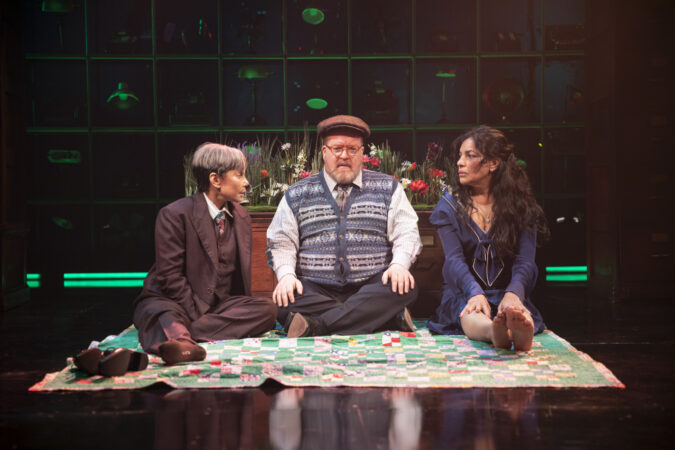
The Adding Machine. By Elmer Rice, revised by Thomas Bradshaw. Directed by Scott Elliott. At the Theater at St. Clement’s (The New Group). Through May 17. 90 minutes, no intermission.
A century ago, Elmer Rice wrote a play about a man who mistakes routine for achievement. Mr. Zero spends twenty-five years adding columns of numbers in an office, and one afternoon, the boss tells him a machine will do it faster. The play that follows is expressionist and relentless, but its real subject is not the machine that replaces Zero. It is Zero’s conviction that he was doing something meaningful all along.
Thomas Bradshaw’s revision for The New Group strips Rice’s sprawling cast to four actors and compresses the evening to ninety minutes. The distillation is smart. What was once a crowded pageant becomes a chamber piece, and the intimacy works for a play whose central terror is personal: not that the world discards you, but that you choose the smallest possible life and feel proud of the choosing.
Derek McLane’s set grounds the production in that anxiety. A wall of dust-covered, out-of-use office fixtures fills the back of the stage. In front of it, the actors work with beds, tables, and bookshelves that serve multiple locations without calling attention to the mechanics.
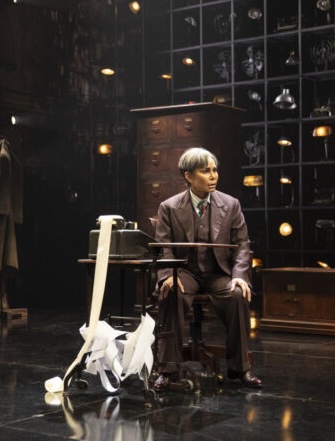 Daphne Rubin-Vega plays Mr. Zero, and the cross-gender casting stops you from settling into the character you expected. Rubin-Vega brings a plainness to Zero that makes the role land as something more universal than a period portrait of a downtrodden man. She is not playing masculinity. She is playing a person who believes choosing which shade of gray to live in counts as ambition. Jennifer Tilly’s Mrs. Zero nags with a precision that walks right up to caricature and stops, and you understand why Zero retreats further into the ledger. Sarita Choudhury’s Daisy is the quiet counter-argument, the co-worker whose devotion offers Zero a life he cannot bring himself to choose.
And then there is Michael Cyril Creighton, who plays everyone else. Audiences may know him as the beloved Howard Morris from Only Murders in the Building. Here he plays every boss, every neighbor, every functionary of the afterlife. He transforms physically, shifts vocal registers without visible effort, and finds emotional weight in roles that a lesser performer would play for laughs alone. He impishly breaks the fourth wall, pulls props from hidden drawers in the set to push the scenes forward, and operates as both narrator and engine. It is one of those performances where you stop counting characters and start watching the architecture of the thing. Creighton is the reason the four-actor gambit works, and by himself, a reason to see this production.
Scott Elliott directs with care and respect for the material. The production is clean and never condescending to its source. But it is also a tedious evening in stretches, and here the revival’s central problem surfaces. A play about machines replacing workers should feel urgent in 2026. It does not, quite. The afterlife sequence, where Zero is reunited with Daisy and offered a real connection only to reject it, gestures at something resonant. He is willingly banished back to the machine because even the hereafter cannot get rid of him fast enough, and the eternal Zero is most comfortable plugged into whatever the next machine turns out to be. But Zero’s particular tragedy, a man so convinced that perseverance is a virtue he cannot recognize when perseverance is the trap, does not map as cleanly onto our current moment as the premise promises. The production senses the connection without finding it. The result is a revival that honors the text without making a case for why the text needs reviving now.
The Adding Machine is a hundred years old, and this production gives it a polished, intelligent reading. The play’s limits are its own. But Creighton, who turns a century-old script into something you cannot look away from, is the reason to be in the room.
The Adding Machine plays at the Theater at St. Clement’s, 423 West 46th Street, New York, NY 10036, through May 17, 2026. Tickets at thenewgroup.org. Scenic design by Derek McLane, costumes by Catherine Zuber, lighting by Jeff Croiter, sound by Stan Mathabane. Directed by Scott Elliott.