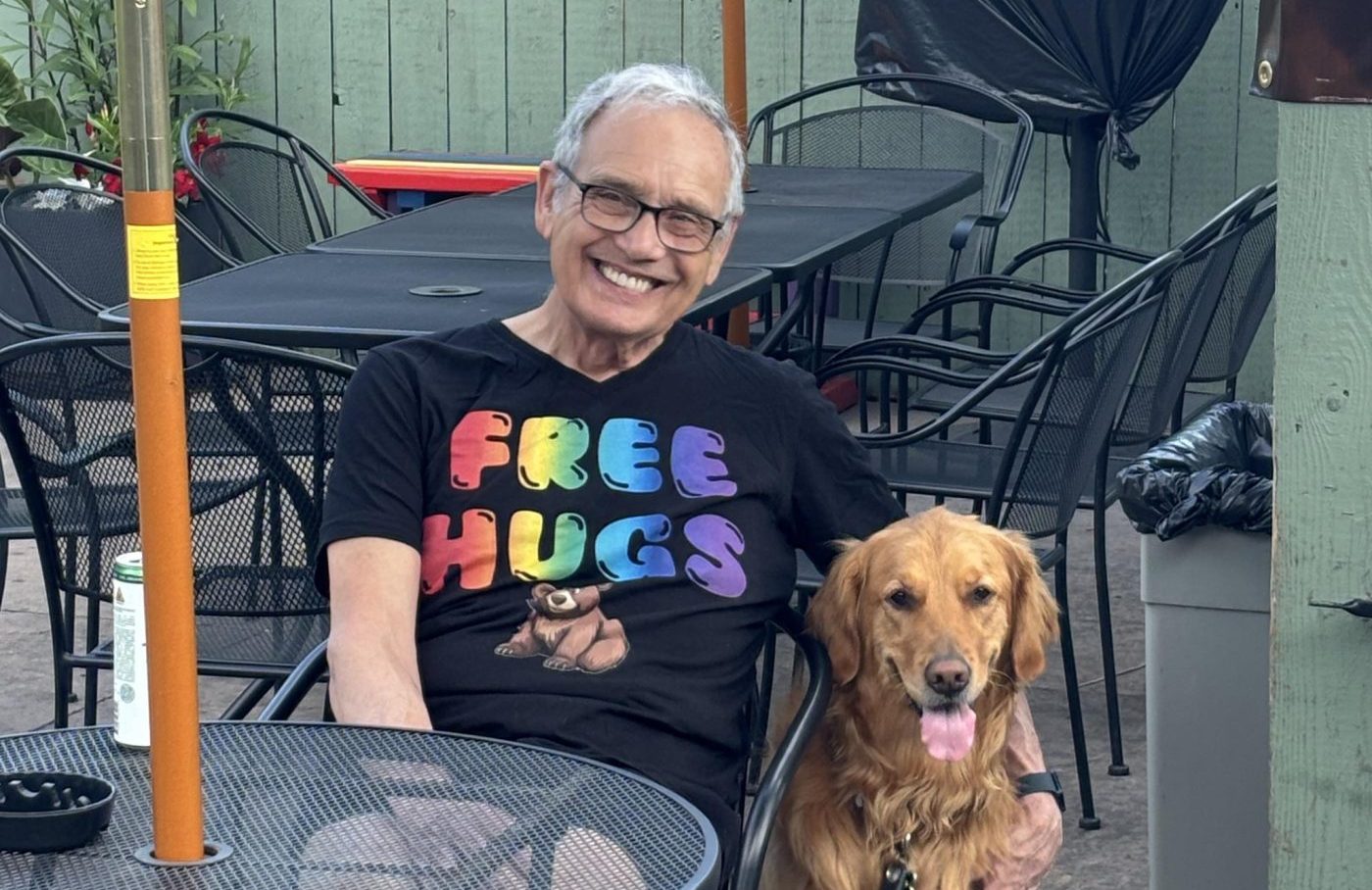
At 80 years old, beloved bartender Joe Hedley describes the three defining eras of his life as the three legs of a tripod: his time in the US Army, his years in San Francisco at the dawn of the AIDS crisis, and his 14 years at Just John.
Though he has received awards from Fair St. Louis, Pride St. Louis, and the City of St. Louis Recorder of Deeds for his volunteerism, Hedley was genuinely surprised to be honored by Out In STL. “I was just living my life,” he said, modestly adding that he felt unworthy of the recognition.
Sitting with him on a Saturday morning in his elegant Lafayette Square condo, the pleasant scent of potpourri candles in the air, a few themes emerged in Hedley’s storytelling. There are few “I’s” and many “we’s” and “they’s.” He has served the community longer than most of us have been alive, doing so quietly, diligently, and without expectation of recognition. Another recurring phrase: “lifelong friends.” He referred to over half a dozen in this way.

Joe Hedley
Finding His Community
When Hedley was drafted in 1969, he says it was safer to risk his life in Vietnam than to come out as gay. He served in the Army and became an infantry officer at 24. After his father’s passing in 1973, he returned to St. Louis, where a new friend named Lynn Smith changed the course of his life.
“She asked what I was doing Friday night, and she took me to my first gay bar, the Potpourri, at Euclid and McPherson,” he recalls. “It was like the weight of the world was lifted. Raised Catholic, I thought something was wrong with me. I thought I was sick.” Soon after, they went to Martin’s, then the original Red Bull—though, as Hedley notes, “everyone said Jerry Edwards owned it, but the gay bars were mob-controlled at the time.”
Hedley came out on February 8, 1974. “Coming out then wasn’t like it is now,” he says. “‘Coming out’ meant coming out to your gay friends.”
Lynn also introduced him to a large gay and lesbian social circle. “It was half gay and half lesbian because to do anything, you had to present as a straight couple,” he explains. “If we went on a cruise, the reservations would be in male-and-female names, and then you’d stay in the room with your partner.”
Fire and Resilience

Joe Hedley
Just two years after San Francisco’s Twin Peaks Tavern became famous as the first gay bar with large, uncovered windows, in 1974, Hedley and his partners opened a gay disco called the Bijou at Maryland and Boyle that was similarly exposed. “We brought in a DJ from New York for opening week. We had light shows…” But security was a constant concern. “We had five guards outside. People were being harassed.” As the only gay bar not mob-controlled, Hedley believes the mob helped stoke the backlash. Six months later, a suspicious fire broke out.
He reopened the bar, but in the spring of 1975, another fire burned the Bijou to the ground.
“I’ve got to give a tip of the hat to Adelaide Carp,” he says, referring to the well-connected wife of Herb Balaban Carp, owner of Herbie’s and Balaban’s. “She was preparing to open a gay disco at Maryland and Euclid, and she called me. ‘Joe, you and I both know who did this. Let them try to burn me down.’”
AIDS and Compassion
In 1975, Hedley became a stockbroker and later a banker. When his bank offered a transfer to San Francisco in 1981, he accepted—arriving just weeks before the first cases of AIDS began to appear.
“Suddenly, there were people with lesions on the bus. You couldn’t hide it. It was everywhere,” he recalls. “There was so much death, and nobody was even trying to stop it. The City of San Francisco had a larger AIDS budget than the federal government until after Reagan.”
Then, still a practicing Catholic, Hedley joined the liberal parish of Most Holy Redeemer in the Castro, even living in the rectory for a time. “They opened the first AIDS hospice and buried over 300 people who had no families,” he says.
Coming Home

Joe Hedley at Just John. 2000
Hedley returned to St. Louis in 1986, continuing his career in banking before buying an industrial painting company. After selling it and retiring in 2010, he still wanted to stay active. “I asked [Just John owners] John Arnold and Jeromy Ruot if I could work there, now hosting 3 Happy Hours a week,” he says. Being surrounded by younger people keeps him feeling young—and he speaks of the bar with deep reverence.
“Just John is similar to Holy Redeemer,” he says. “People might be surprised by that comparison, but they do so much behind the scenes. They support so many and give so much. For example, they fund the Women’s Flag Football League—not a team, the entire league!”
The bar gives him free rein to plan events, including a series of Monday night history gatherings. Hedley wants to keep LGBTQ+ history alive, but cautions against older generations lecturing the young about how they were fighting for them. “We weren’t fighting for the next generation,” he says. “We were fighting for ourselves—just living our lives.”
Hedley feels incredibly fortunate to have the support of his family. “I truly could not have done anything that I did in my life without my family. I talk about the three legs of the tripod, but the stool that they support, and that I sit upon, is truly my wonderful family. They are nothing but supportive, of not only me, but of our entire community. Because of living this long, I have become the patriarch of a 4 generational family, with the oldest person in the fourth generation being 25 years old, which means I am hopeful to see the fifth generation. My family matters so very much to me. I realized that everyone in our community has not had this support. I am lucky indeed!”
 A Lifelong Friend to the Community
From his service in the military to his compassion during the AIDS crisis to his years behind the bar at Just John, Joe Hedley’s life has been defined by service. Through it all, he has given our community stability, courage, and connection—and in return, we’re fortunate to call him a lifelong friend.

