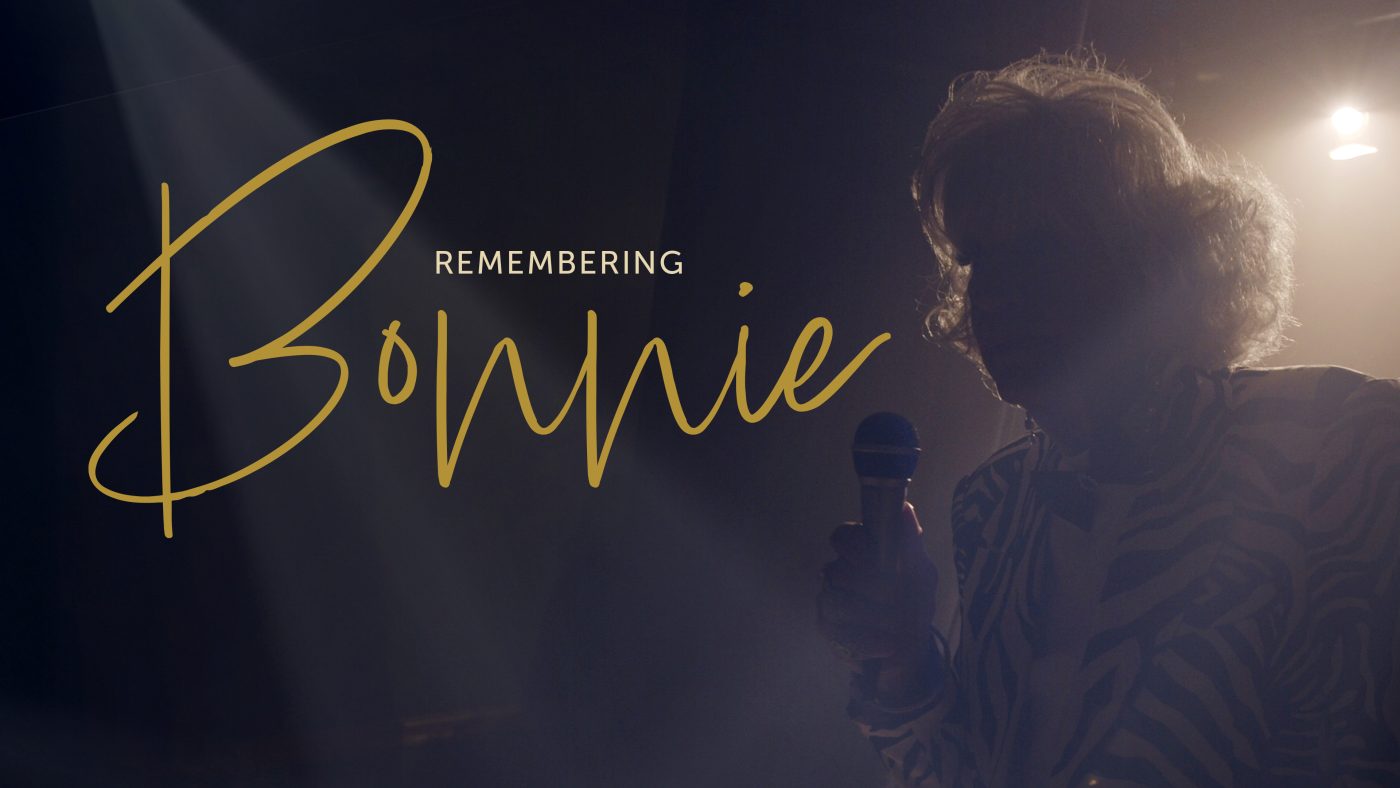
At 89 years old, sitting behind her big wooden desk at the front of her sleepy South Broadway antique store, Bonnie Blake could have never imagined how interesting her life was about to become. In walks Geoff Story, a documentary filmmaker seeking to interview her for a documentary about found footage of a 1940s gay pool party. He quickly determines that she is simply too big, too magnetic, to be a mere clip in a film. Bonnie Blake, who had been performing in drag since 1956, is worthy of a documentary of her own.

Geoff Story visiting with Bonnie Blake at her antique store. Photo credit: Geoff Story
Story would soon become Blake’s personal biographer, handler, agent, paparazzi and dear friend. He was so invested that he even rented an apartment above her store, although he didn’t actually occupy it. “I thought the interviews would be more natural and organic if I was close by,” he said in an interview we did in 2020. When I said I’d like to see the place at the time, he replied dryly, “Right now it’s full of mannequin heads.” He had purchased a few mannequin heads from Blake, and after that she thought it was hilarious to randomly place mannequin heads around the apartment.
Like many celebrities, Blake feigned irritation with the paparazzi. One night out, Story worried that filming might be too intrusive, so he left his equipment at home. Despite her supposed exasperation from being in the spotlight, Blake was clearly disappointed. “You didn’t bring the cameras?” she asked.
In 1945, when she was 17, Blake left the Kentucky farm where she was raised and moved to the eighth-largest city in the United States, St. Louis. She told me that she first walked through the door of the building housing her antique store soon after her arrival. “This place was a bar, and I was here to go dancing,” she said. It remained her store for five decades, and then she kept it “in the family” by selling it to Bar:PM in 2021. People once again dance there.
On Sunday, August 17, about six weeks after she passed away at 96, friends and family gathered in that very space to pay tribute. St. Louis LGBT History Project founder Steven Brawley had artifacts of her colorful life on display, including her trademark blond wig, and her fellow Broads of Broadway members paid their tributes, which were sometimes hilariously irreverent, and other times deeply moving. Lady Shirelle described how difficult it could be to get bookings as a Black entertainer in the old days, and became emotional when recalling how Blake kept her and entertainers like Candy Principle booked.
The highlight of the event was a half hour of Story’s beautiful, poignant footage of Bonnie Blake projected onto a large movie screen. We were welcomed into that special friendship, where we heard, for the first time, Blake like we had never heard her before. She spoke of wearing her sister’s dresses as a little boy, to the annoyance of her sibling, until her Pentecostal father brought Blake dresses of her own. She contemplated whether she should have had a sex change, while acknowledging that her success (she owned all but one building on the 7100 block of South Broadway at one time) required being male-presenting. She told the story of earning the Purple Heart in the Korean War. She spoke of having lived a full life and how she envied the birds, wishing she could fly away with them.
You could think of a celebration of life as an encore performance: The deceased speaks through those who love them. The addition of Story’s film took this experience to a new level, bringing Bonnie Blake back to her home stage to take one final bow at the close of a historic run.
SCROLL DOWN FOR IMAGES

Bonnie Blake

Bonnie Blake

Bonnie Blake

Bonnie Blake

Bonnie Blake. Photo credit: Geoff Story

Bonnie Blake. Photo credit: Geoff Story

