I met Flowing Johnson in 1994 through the St. Louis chapter of the (then-called) Gay, Lesbian, and Straight Teachers Network (GLSTN), which I started that summer. She and I were teachers – community college math for her and high school social studies for me. In her mid-50s at the time, Flowing had long ago developed an iron sharp understanding of social movements, activism, and peaceful confrontation politics. I was not yet 30 and knew little about the machinery of social change.
Later that year, or maybe the next, Flowing invited me to join another St. Louis-area group, WOAR (pronounced war) – Whites Organizing Against Racism. At each meeting, a WOAR member would present something pertinent to the deconstruction of white racism. When my turn came, I chose to talk about a writing that had changed my life: Martin Luther King’s Letter from Birmingham Jail. My activism back then, however, was naïve and surfacy. If everyone would read more MLK and study more history, I believed, white people would wake up, the “race problem” would be fixed, and overnight we’d all be next-door neighbors in the Beloved Community village. Flowing had been in the human rights movement for a quarter of a century already – and she was everything but naïve and never surfacy. She understood the slogging progress of change making.
She listened attentively to my Birmingham Jail presentation and helped carry forward my weak attempts at engaged discussion. She also challenged (mentored) me toward a far more accurate understanding of the impact of centuries of deep, intractable, systemic, and psycho-emotional infrastructure that supports white-male supremacy in the United States, which of course makes a national healing more complicated, more fraught with setbacks, and far less likely to be achieved than I imagined. Looking back, I cringe recalling my shallow and amorphous ideals, but Flowing never made me feel wrong or less-than. Instead, she guided me with challenging and insistent questions, warm smiles, and occasionally a little “he’ll learn” smirk.
Flowing and I also organized a 1995 LGBTQ+ History Month event in St. Louis – a small ceremony that October at the gravesite of Tennessee Williams. Flowing was the opening and closing speaker. I have no recall of the insufficient words that I probably spoke between her polished and confident ones. Flowing’s language, after all, always cut directly to a core truth.

A lasting happy memory from that 1995 event occurred when we did the reconnaissance a few days prior to the gathering to locate Williams’ gravesite at Calvary Cemetery. Flowing’s partner, Marcia Levin, drove. Flowing was in the passenger seat. I was in the backseat. The pre-Civil War Catholic cemetery of nearly 500 acres is laced with narrow, confusing roads and we got a little lost. Upon rounding our hundredth curve, right in front of us, straight ahead, stood a huge crucifix with Christ glaring in our direction. Flowing shouted: “There he is! The Big Guy!”
My (at the time) religious spirit was a little shocked, but every time I’ve thought of that moment thirty years ago I’ve smiled, and there’s a deeper point here, too: Flowing was decades ahead of me and most others in deconstructing religion – as a philosophy that is helpful and harmful, as a protector of male supremacy, as a cause of numerous long-delayed human rights gains. (It still is.)
During an oral history interview at the 2010 SAGE National Constituent Conference in NYC, just before her 70th birthday, Flowing described herself as a “kick-ass activist.” Going all the way back to the late 1960s that is who she was – engaged across the decades in direct action civil disobedience on feminist, lesbian, anti-war, reproductive freedom, and justice issues. She helped start Women Rising in Resistance in 1985 and, for example, organized at the Old Courthouse in downtown St. Louis what might have been the first protest in the nation against the Bowers v. Hardwick ruling of June 1986.
Flowing was also there with her partner Marcia when Queer Nation St. Louis was organized in 1991. Speaking at the launch of the Mapping LGBTQ St. Louis project in October 2017, Flowing recalled an Easter Sunday 1992 action with about 100 Gateway City activists of Queer Nation, ACT UP, and Catholics for Choice held outside the Cathedral-Basilica on Lindell. The St. Louis action was a non-obstructive protest, smaller and more quiet than the famous 1989 ACT UP Stop the Church protest at St. Patrick’s Cathedral in New York. Some picketed back and forth, others stood quietly with their backs to the church, and some placed SILENCE=DEATH stickers on their mouths. Three crosses were carried aloft in front of the church, each representing different constituencies: AIDS, WOMEN (abortion rights), HOMOSEXUALS. During the Mass inside, the demonstrators staged a die-in on the sidewalk outside, outlining bodies with chalk visible as parishioners left the Easter service. When it was all over, Flowing and the protestors, she said, “went to brunch.” Flowing also participated in Queer Nation same-sex hand-holding demonstrations at the Galleria Mall and sit-down protests at the Cracker Barrel in Caseyville, Illinois, after the corporation had fired a lesbian server. “Queer Nation was a ball. We had a great time!” she recalled.
In her late 60s, she began a new type of activism – working on behalf of older LGBTQ people with the St. Louis SAGE chapter. She also advocated for simple things like biker and walker safety. And when only Jackson County, St. Louis, Kansas City, and Columbia had domestic partner ordinances, Flowing and Marcia, already together for more than 25 years, helped the University City mayor achieve city council approval of a domestic partner ordinance, the first St. Louis County municipality to do so. After passage, Flowing and Marcia were domestically registered in their longtime city.

Flowing and Marcia in an article about the passage of the domestic partnership ordinance in University City.
When Gateway to Pride opened at the Missouri History Museum in June 2024, her lifetime of work was recognized in the exhibit and Flowing was there to see it. I snapped images of her reading the entry about her legendary work and beaming with satisfaction. A few feet away, I asked if she’d take a photo with me next to the display of my 1990s work. “Sure!” she said, then grabbed my hand in solidarity, mentor to mentee.

Photos at the opening of the Missouri History Museum’s Gateway to Pride exhibit.
I saw her next, again at the Missouri History Museum, in April 2025, in attendance to hear the historian John D’Emilio talk about his forty-year career researching and recording LGBTQ history. Two months after Marcia’s death, her beloved partner of 42 years, Flowing was learning to embrace the aftermath of enormous loss and re-engage with her community, determined to walk into the future remaining before her.

Margaret Flowing Johnson, Rodney Wilson, Jym Andris and Joe Lampe at the Missouri History Museum for the Primm Lecture on History. Photo by Philip Deitch.
The last time I saw Flowing was in June, at her University City home. She had a list of things she needed a little help with: Packing up some of Marcia’s clothing for Goodwill. Mailing a package. Moving suitcases into an upstairs closet. Changing a light bulb. Little annoyances that she could no longer tackle herself.
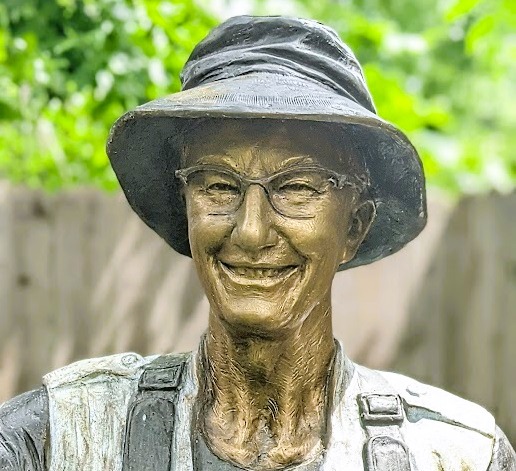
With chores done, we sat at her dining room table, looking through her large patio door overlooking a lawn with a life-size bronze sculpture of Flowing the Bird Watcher standing in the far corner. Marcia’s family had commissioned it. At the time, Flowing thought the entire idea of being immortalized in bronze was a bit weird, but she grew to love how the image captured the ecological side of her personality. “That statute years down the road when you’re not here needs to be on the lawn of the Missouri History Museum!” I told her. “That sounds like an idea. Think they’d be interested?” she asked.

Snapshots taken during the June 2025 visit to Flowing’s home.
Flowing’s last Facebook post, in late November, was of the bronze Flowing covered in the first snow of her 86th winter.

The passing of formidables like Flowing naturally brings community-wide notice, including from many who knew her far better than I did.
She was, wrote her decades-long friend Kris Kleindienst, “a just do it out lesbian intersectional activist….[who] preferred direct action and was the master of civil disobedience… There wasn’t a demonstration about any issue that [Flowing] wasn’t marshalling around the borders of, keeping it peaceful and on point.” With “a strong moral compass and a deep unwavering commitment to social justice for all,” everyone is indebted to Flowing: “If you are in St. Louis’s streets today as part of your activism you are standing on Flowing’s shoulders.”
Another community pillar, Joan Lipkin, wrote: “I knew her for years. She was my kind of feminist and deeply committed to causes I support like ecology and reproductive choice and racial justice. She was the kind of person who you could count on when you needed something that would benefit the community….What a woman.” “Deeply principled and generous,” Flowing “put her beliefs into action. She once literally gave me the shirt off her back because I needed it for a costume….[She] will be forever loved and forever missed.” When Lipkin produced the piece “Becoming Emily,” about abortion care provider nurse Emily Lyons, shortly after Dr. George Tiller was murdered, terrified of a possible attack and unable to procure security services, she turned to Flowing, who provided “a whole line of feminist escort security that included her and her partner Marcia Levin.”
Naming Flowing “our newest lavender ancestor,” St. Louis LGBT History Project founder, Steven Louis Brawley, wrote that Flowing was “an inspirational mentor and community leader [who] focused on action and took on power structures without fear.”
Born in Des Moines, Iowa, in November 1940, Margaret Katherine Johnson, taken name Flowing, was decades ahead of her Silent Generation peers – and she was never silent! She saw through the gild of a respectable conformist world to the reality beneath – an actuality that too often was ugly and profane, denying full citizenship rights to some, and stripping human liberty from women, people of color, and “queer” outsiders. During her entire long life, Flowing maintained a consistent and sustained vision of an improved world. She never stopped walking toward that better city and she never left behind anyone traveling in the same direction, including me. While Flowing’s voice went silent on January 20, her focused light remains a beacon for all who knew her.
To learn more about Flowing’s extraordinary life, and to hear her voice, this 35-minute oral history interview recorded in 2017 as part of Washington University’s Documenting the Queer Past in St. Louis project contains recollections of her lifetime in St. Louis, beginning in 1964, with references to many progressive organizations, community activists, and civil disobedience actions. Additionally, Flowing’s obituary is here.
Rodney Wilson is the founder of LGBTQ+ History Month.