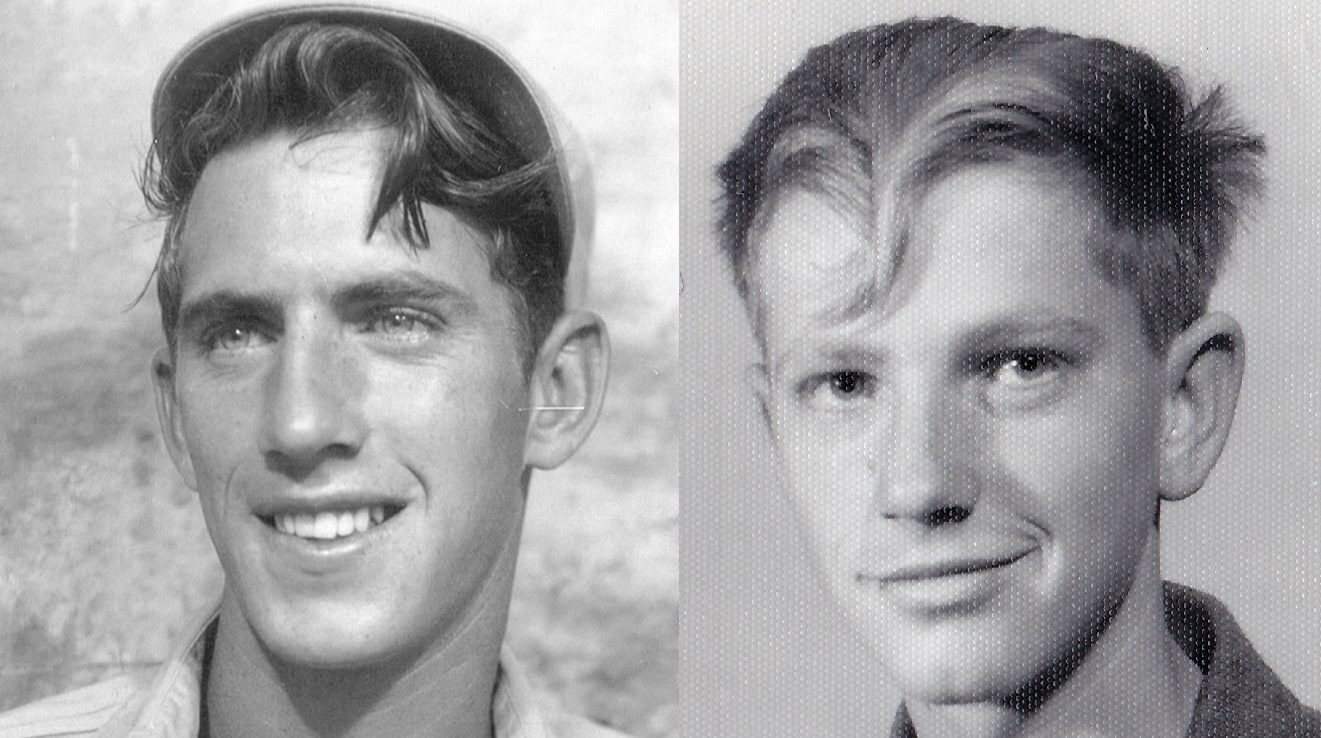
One of my mother’s older brothers, Paul Monroe Gamble, died in an automobile accident eleven days before Christmas 1959. He was 24. Twenty years later, in January 1979, my mother’s youngest brother, Clifford Lee (Ricky) Gamble, also died in an automobile accident. He was 29, the youngest of eighteen children.
Uncle Paul died before I was born. I know him only through photographs and stories. Uncle Ricky died the month I turned 14. I remember him well. What I didn’t know at the time about either of them — because it was unknown to most family members and kept secret for decades by the few who knew — was that both uncles had engaged in same-sex relationships.
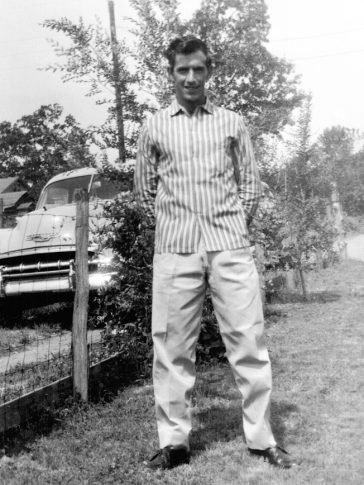
Paul Gamble (1934-1959), pictured in 1958.
Uncle Paul was tall, handsome, and fastidious about his appearance and clothing. Mom once saw her decade-older brother standing in front of a mirror curling his eyelashes. It seemed odd to her, and she stared quizzically, trying to figure out what was going on. Uncle Paul interrupted her thoughts and answered her unspoken question: “I like to curl my eyelashes when I’m going out because the girls like it.”
He was a country boy from poor and rural Washington County living with his sister, Cookie, in neighboring Jefferson County, primarily to be closer to employment opportunities in St. Louis. He worked as a punch press operator at S.G. Adams Company, at 10th and Olive. After a mid-December Monday at work, he and his commuting buddies were on their way home when a drunk driver crossed the median and slammed head-on into their car.
According to his death certificate, the two-car accident happened at 4:15 p.m. Uncle Paul was pronounced dead at Jefferson Memorial Hospital in Festus (now Mercy Jefferson) at 5:45. The cause of death was listed as multiple fractures.
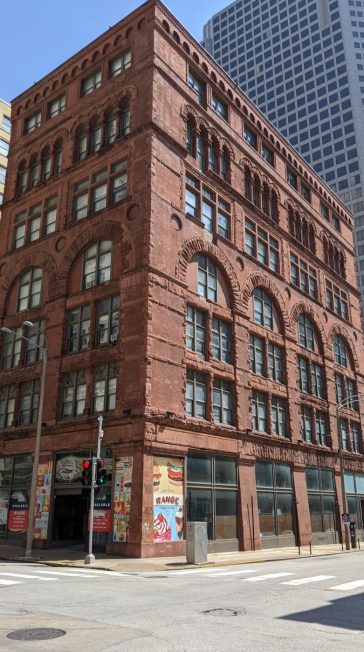
Photo from the last time I drove by the former S.G. Adams Company building, August 2026.
Uncle Paul was gone. The 1889 red sandstone building that he walked out of earlier that day still stands, dwarfed by larger, modern buildings all around it, and when I have occasion to drive by, I feel Uncle Paul’s ghost lingering around the old building where he spent his final hours.
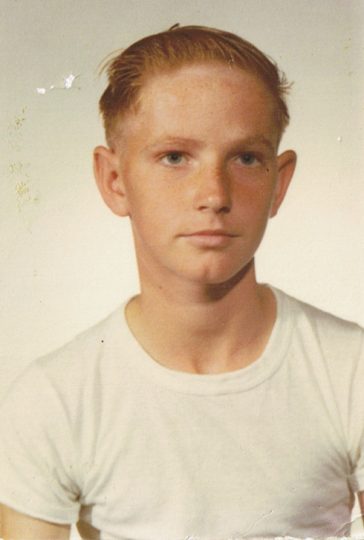
Ricky Gamble (1949-1979), in a ca. 1965 school photo.
Uncle Ricky, handsome and ruddy with red hair, had a hard life. Looking back, I suspect he may have struggled with learning disabilities, dyslexia, and attention deficit. More troubling than these difficulties was alcoholism, which began in his early teens.
His hands trembled when he was not drinking, at family events for example, and when he slept on my parents’ couch where the morning drink was coffee, not alcohol. When I remember Uncle Ricky, I see a thin, withdrawn man trying to steady his freckled hands.
Uncle Ricky was killed by a drunk driver, too — his friend — when their car skidded off a sleet-filled road after an evening at a hilltop bar, overturned, and landed in the ditch outside another uncle’s home. Nearly 50 years later, I still hear Mom’s scream and I still see her collapse after Dad quietly uttered the two awful words: “Ricky’s dead.”
These are the stories and remembrances of my uncles that I grew up with. Not until the early 1990s, after I came out to my immediate family, did a fuller account of their lives emerge when Aunt Cookie, with whom Uncle Paul lived at the time of his death, told Mom that a man came to her home shortly after Uncle Paul died and told her that he and Uncle Paul had “really loved each other.” (I wrote about this, including my conversation decades later with that same man, then elderly, in a 2016 essay.)
I learned about Uncle Ricky’s same-sex relationship from one of my dad’s brothers, a gay man who was aware of 1970s sexual encounters involving Uncle Ricky and another man. While it’s impossible to know with certainty how either uncle understood his sexual orientation, Mom is “100% convinced” that Uncle Ricky was gay: “He never once had a girlfriend or talked about a girl.” She feels the same certainly about Uncle Paul.
Mom’s gift for Uncle Ricky for Christmas 1978 was a brown turtleneck sweater. With his chaotic life, bouncing from home to home, Mom wasn’t able to find him that December and the undelivered present was placed on the upper shelf in her bedroom closet, waiting for the next time she saw him. Unfortunately, a next time never came. He was dead by February.
A few weeks after his death, a man whom Mom had never met startled her at her place of work, the hometown Walmart, because he looked so much like her recently-deceased brother. Mom struck up a conversation and asked the man to return the next day because she wanted to give the turtleneck sweater to him. He returned. She handed Uncle Ricky’s gift to him. And she never saw the stranger again.
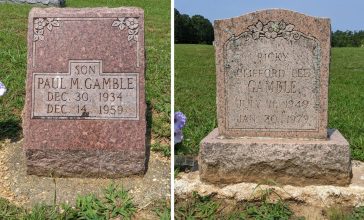
Paul’s and Ricky’s grave markers, New Diggin’s Cemetery, Washington County, Missouri.
Uncle Paul and Uncle Ricky are buried in a small cemetery in our home county. Their parents rest next to them, as do two brothers who died in infancy, and a brother who lived to be 85.
Uncle Ricky’s death was always eerily anticipated, as he had narrowly survived another car accident a couple of years prior, and the fearful expectation of bad news made his death a little less jarring. Uncle Paul’s unanticipated death was a destructive lightening bolt that sent shockwaves through the family for decades. (My mother wrote about his death and the aftermath here: “The 1950s Are Over.”)
When I imagine what might have become of my two uncles had they lived beyond their 20s, I always conjure up a happy ending. Uncle Ricky frees himself from alcohol, finds a warm heart and a good man to enjoy life with. Uncle Paul finds a great love, too, and moves to St. Louis. When I move to the same city in 1990 to begin my career in education, he’s in his mid-50s, living a quiet life with his partner, and we all become close friends.
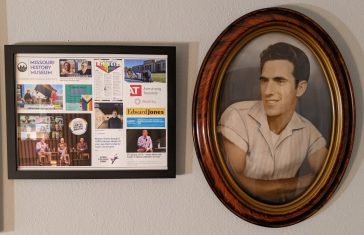
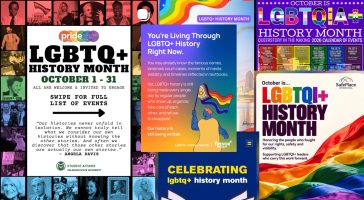
Collage of images (left) from History Month 2024 and (right) the gift Aunt Cookie gave to Grandma Gamble for Christmas 1960.
The Christmas after Uncle Paul’s death, his sister Cookie had a recent photo hand-colored and placed in an oval bubble-glass frame. It hung on my grandmother’s wall until her death in 1978, when it passed to Uncle Paul’s twin sister, Pauline. It remained on her living room wall until she died in 2002, when it passed to Mom’s family. The photograph is mine now. It hangs in my office, a few feet from where I’m sitting, deliberately placed beside a collage of photos and screenshots from engagements during LGBTQ+ History Month in 2024, what would have been his 90th birthday year. I look at Uncle Paul often. And I wonder about what might have been.
Rodney Wilson founded LGBTQ+ History Month in 1994 and co-founded the International Committee on LGBTQ+ History Months in 2021.