 In October 1965, the Rev. Robert Watson Wood, along with three other protestors, appeared on the cover of The Ladder, the monthly publication of the Daughters of Bilitis, the first national organization for lesbian women in the United States.
The cover photo was taken the previous June, when Rev. Wood and two dozen others — including Frank Kameny, Barbara Gittings, and Kay Lahusen (who took the photo) — walked a picket line for two hours at the plaza of the Civil Service Building in Washington, D.C., protesting the ongoing federal government purge of LGBTQ employees. Rev. Wood was the only minister in the group, and he wore an identifying clerical collar.
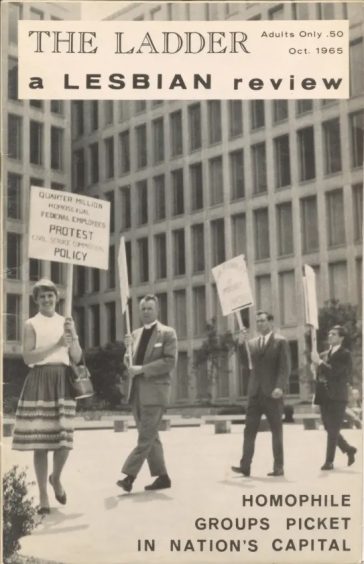
October 1965 issue of The Ladder
Five years prior, in 1960, Rev. Wood published Christ and the Homosexual, a 221-page treatise about the homosexual (that day’s terminology) and the Christian church. Rev. Wood’s real name appeared on the cover and his photo on the dustjacket. He dedicated his book to “lonely and rejected homosexuals who feel damned” and to “my fellow clergy who damn the homosexual,” and he wished the same for both: “May you find in these pages the Light that is Jesus Christ.”
Bob’s book won the 1960 Mattachine Award for Merit, “for active promotion of individual freedom and education in the human community.” ONE Magazine called it “sparkling, intimate, compassionate and well informed.” The Ladder co-editor Del Martin reviewed the book as a “courageous step” and “no timid venture.” Indeed, it was a radical manifesto for 1960, a strong call for the Christian religion to reconsider its theologies and doctrines about LGBTQ people. (A full text of Rev. Wood’s Christ and the Homosexual is here.)

Published in 1960
The 1960 publication of this groundbreaking book and his attendance at a public gay rights demonstration in 1965, protesting the prejudice of the United States government, is even more remarkable in Rev. Wood’s case because he himself was a deeply closeted gay man. His parents did not know. His only sibling did not know. His congregations did not know. Rev. Wood himself would not come out as openly gay until the early 1990s, after the deaths of his 95-year-old mother in 1991 and his partner of nearly 27 years in 1989.
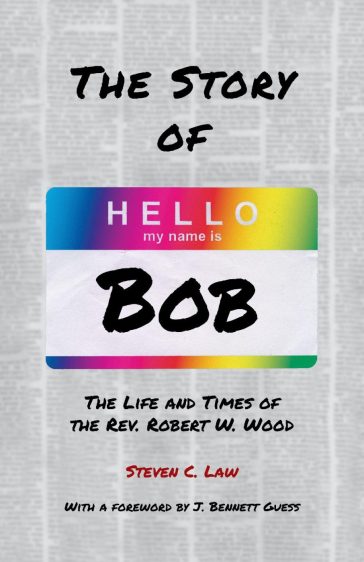
The Story of Bob: The Life and Times of the Rev. Robert W. Wood, an insightful and engaging new biography by Steven C. Law, is, therefore, the story of a deeply closeted man who also is an LGBTQ rights pioneer.
Bob Wood was born in Ohio in 1923. He grew up in a stable, middle-class, educated, Theodore Clever household. His nurturing mother (born in 1895) was devoted to caring for the domestics of family life and his wise father (born in 1889) funded the operation. His parents were tender and kind, considerate and thoughtful, gently doling out advice to their son, the future Rev. Wood, and Wood’s older brother, Harold Jr.
Young Bob did what most gay boys did then and still do: he tried to be the perfect student, the perfect son, the perfect brother, all required to make up for his grave deficiency – being gay – with the hope that when that degradation (as most at the time viewed it) became known, his former goodness would somehow be enough to outweigh the new infamy. Raised in a Christian home, and born with a religious orientation, Bob also wanted to be perfect for his minister, his Sunday school teacher, and for his god.
Within a decade of his birth, the Great Depression was affecting every American and Hitler had taken power in Germany. After the Japanese attacked Pearl Harbor in 1941, Bob volunteered for the U.S. Army (his father was WWI Army), swore that he “liked girls” (as required), and was shipped off to the Mediterranean. At twenty-one, he was shot through the chest while climbing Monte Cassino near Naples, where Germans had occupied the high-on-a-hill Benedictine monastery site, which made easy targets of approaching Allied troops. Recovery from the near-fatal chest wound took nearly two years.
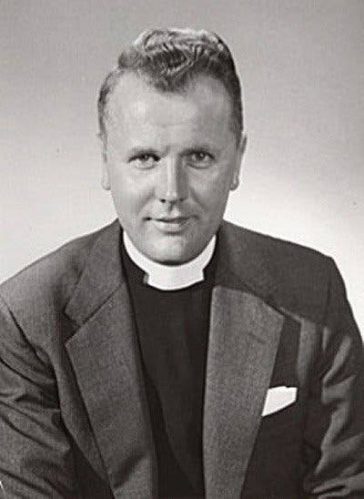
Rev. Robert Wood (1923-2018)
After the war, Bob completed undergraduate work at the University of Pennsylvania and seminary at Oberlin. He was ordained in 1951, after which he commenced a long career as a minister in four churches over the next thirty-five years. He retired in 1986, largely to have more time to care for his elderly mother and ailing partner, Hugh Coulter, an artist and former rodeo cowboy.
Bob and Hugh never lived together nor openly acknowledged their relationship, outside of a small group of close friends. When the ambulance arrived to remove Hugh’s body from his home (he died in his sleep at 69), when asked about his relationship to the deceased, Bob, who had been staying at Hugh’s home during the Christmas 1988 holidays, told the first responders that he was “Mr. Coulter’s pastor.”
Only after Hugh’s death did Bob, about the time he marked his 70th birthday, begin to live publicly as a gay man. He even had a coming-out conversation with his conservative older brother, which is detailed in this biography, as is the overall disappointing relationship with his brother and sister-in-law, who seemed far more interested in telling Bob about their heterosexual lives and their children’s lives than in hearing about Bob’s life.
Rev. Wood died in New Hampshire in 2018, three months after his 95th birthday. His death was marked by the New York Times. The funeral home obituary referred to Rev. Wood as “a pre-Stonewall gay activist.” His ashes were buried beside those of his longtime partner, Hugh, at the New Hampshire State Veterans Cemetery.
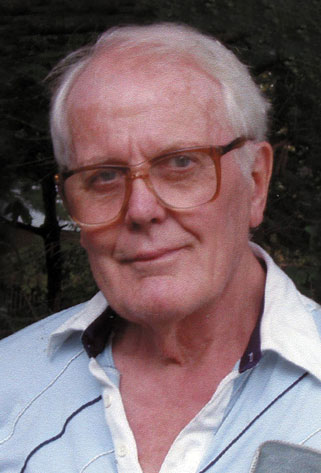
Rev. Robert Wood in his retirement years
Rev. Wood’s life was long and consequential. Hoping to be remembered, Rev. Wood engaged Steven Law to write his biography. After Rev. Wood’s death, Mr. Law seamlessly pieced together from Bob’s archive of personal papers, sermons, and World War II diaries, and from Bob’s notes and from recorded interviews with Law, this new first-person biography, published by United Church Press, the publishing arm of Bob’s United Church of Christ denomination.
This inspiring and instructive – and sometimes sad – account of Rev. Wood’s life establishes him as a pioneer of LGBTQ rights generally and queer spiritual rights specifically, even though for most of his life Bob was unable himself to take advantage of the liberties for which he fought.
Mr. Law, the biographer, has done a great service to the canon of LGBTQ history. As Rev. Dr. J. Bennett Guess, former executive minister and national officer of the United Church of Christ, wrote in the book’s preface: “Bob Wood is a name that LGBTQ people and our allies, especially open and affirming Christians and faith-based justice advocates, should recall with immense gratitude and pride.” Rev. Guess is right and, fortunately for us, Steven Law has now carved Rev. Wood’s name into our memories.
In 2012, Rev. Wood was named an LGBTQ Icon by the Equality Forum History Month Project. Next month, October 2026, will be the 33rd annual LGBTQ+ History Month USA. Reading The Story of Bob: The Life and Times of Rev. Robert W. Wood is a great way to mark the occasion.
Rodney Wilson is the founder of LGBTQ+ History Month USA and the co-founder of the International Committee on LGBTQ+ History Months. He has been a teacher since 1990.