I first blew into St. Louis from Oklahoma in 1997, at age 22. I remember hearing about this city’s larger-than-life household names as I was learning the ropes. There was nightclub owner Howard Meyer, who would entertain in his opulent West End mansion. There were entertainers everyone flocked to see, like Dieta Pepsi, Petrina Marie, Michelle McCausland and Tumara Mahorning, and there was photographer Scott Lokitz, with his pink neon triangle in the window of his shop and studio on Russell.
It can be easy to forget that, in the not-so-distant past, we weren’t all walking around with cameras in our pockets. Being a photographer required a real investment of time and money — a relatively rare skill honed through years of practice and plenty of time in darkrooms (and not the fun kind). It was a distinct and defining role, especially within marginalized communities. And back before we were all community photographers, the community photographer was Scott Lokitz.
Born This Way
It seems Lokitz was always a gay photographer. At four years old, his favorite toy was a Fisher-Price camera. By 6, he had graduated to a Kodak Instamatic.
At 9, Lokitz attended an all-boys summer camp. The campers staged a play. Lokitz starred as the grieving widow and apparently slayed. When the performance ended, the little diva fought to keep the dress. “In the third grade, I had a Simon and Garfunkel poster I kissed every day,” he says.
Around that same time — 1973 — his earthy mother came out to him as a lesbian. Lokitz himself never really had to come out.
At 12, he joined an all-Black Boy Scout troop, where he found his first boyfriend. He later had a high school sweetheart.
Coming Into Focus
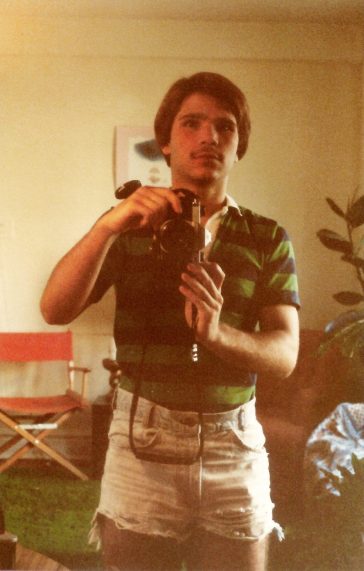
Scott Lokitz. Photo credit: Scott Lokitz
The drinking age in Illinois was 18, but Lokitz was already a regular at Faces by 17, not to mention the St. Louis bars.
“We all had fake IDs,” he said.
Unlike today, taking photos of queer people in bars was typically frowned upon. Still, Lokitz was so steeped in the scene that he found many acceptable places to point his camera and immortalize history.
“My first gay pride in St. Louis was in April 1980,” Lokitz recalls. “I was joined by my mother and grandmother that year. My grandmother was part of PFLAG.”
He remembers a lot of pink; the rainbow flag had not yet really taken hold. “My first sighting of the rainbow flag in St. Louis was in 1986,” he recalls. That first Pride march had no formal program. At the end of the event, people simply
mingled at Washington University.
In 1987, at age 23, Lokitz moved to Salinas, California.
“Within a year, I landed a job at a camera store Ansel Adams had patronized,” he says. “I’d see his Cadillac with the ‘ZONE 5’ plates around town.”
Lokitz returned to St. Louis in 1991 to rekindle the romance with his high school boyfriend, Patrick Crane.
“We were together for about 10 years, and I called him my soulmate and best friend before my partner. We separated in 2001 because of his mental anger, and he took his own life in 2005.”
From 1992 to 1996, Lokitz photographed PrideFest on a volunteer basis before becoming the organization’s official photographer in 1997. That same year, he formed an LLC.
While Lokitz loved taking photographs, he sometimes found the business side of photography tedious.
“An eight-hour festival could take 40 hours to edit, sort and select,” he says, adding that designing a wedding album could take another 40 hours. “That didn’t make my heart sing. Plus, I was spending more [money] on film and processing than on my mortgage,” Lokitz says.
All-Access
Because professional photography was comparatively rare, Lokitz was granted access to A-list talent, photographing dozens of celebrities, from Cher to the Jonas Brothers. He has also photographed politicians ranging from Hillary Clinton to Joe Biden.
Even as late as 2000, Lokitz was one of only a few dozen photographers covering the sold-out Equality Rocks concert at Robert F. Kennedy Stadium in Washington, D.C. The event drew roughly 45,000 attendees and featured George Michael, Melissa Etheridge, Garth Brooks, Pet Shop Boys, k.d. lang and Chaka Khan. Lokitz was a few feet from each of them.
Life & Legacy
Lokitz has converted that storefront on Russell into a gorgeous home, which he shares with his husband, Glen Starks. His mother lives right across the street.
Five years ago, he wrapped up his remarkable run with Pride St. Louis.
“I finally got to retire from my official term in 2021 when I handed the reins over to another person on my photo team, Mark Moore,” he says. “He still leads the team today.”
Today, the seemingly ageless Lokitz takes photos just like the rest of us: by pulling a phone from his pocket.
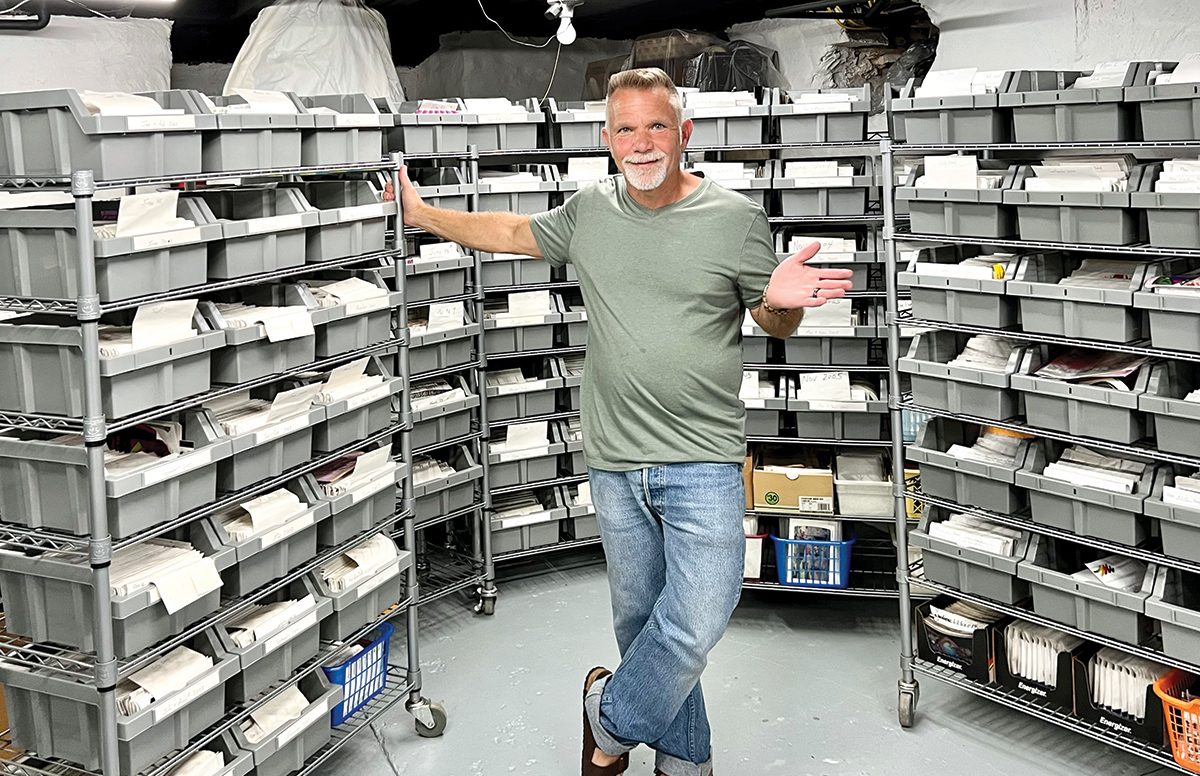
His basement serves as a meticulously organized photographic archive of the St. Louis LGBTQ community — tens of thousands of photos labeled by event, location and year. It feels like an act of time travel to riffle through them.
“I’m looking forward to a point when I can start digitizing and sharing some of my older photographs with the greater St. Louis Community,” he says.
Lokitz has not only secured a remarkable legacy for himself through his life’s work, but he’s also immortalized generations of community members, capturing beautiful faces in the prime of their lives, at one with their tribe.
SCROLL DOWN FOR PHOTOS
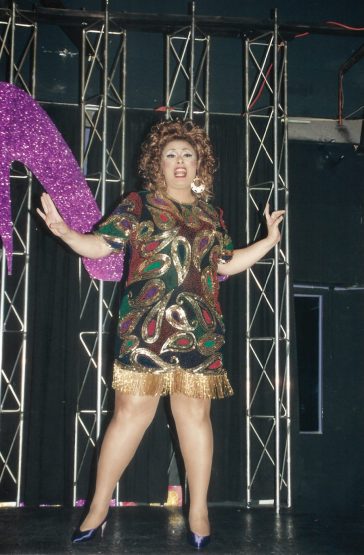
Dieta Pepsi, 1996. Photo credit: Scott Lokitz
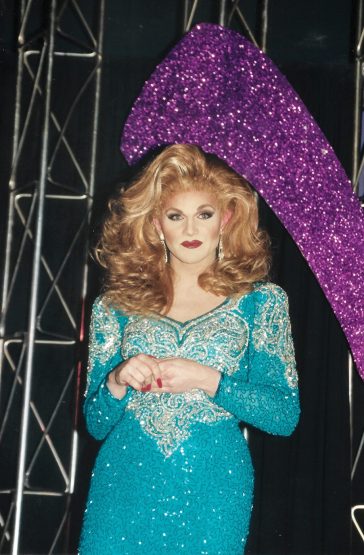
Vicki Vincent, 1996. Photo credit: Scott Lokitz
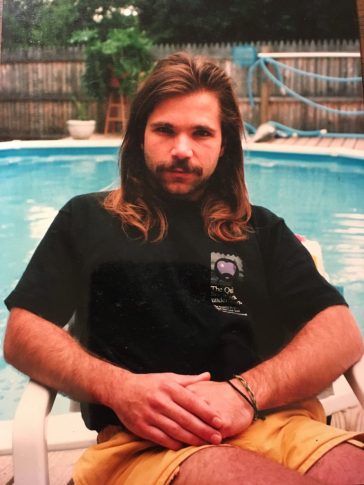
Scott Lokitz, 1994. Photo credit: Scott Lokitz
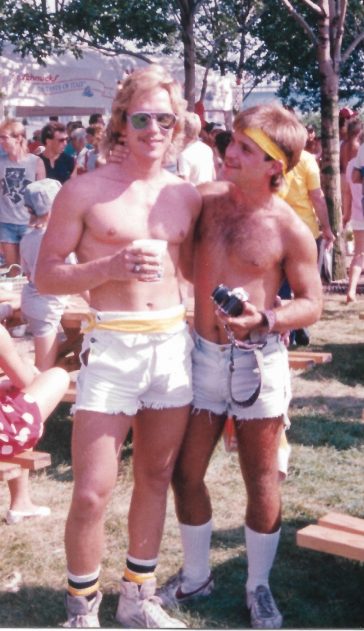
Bill Gaddo and Scott Lokitz, 1986. Courtesy of Scott Lokitz
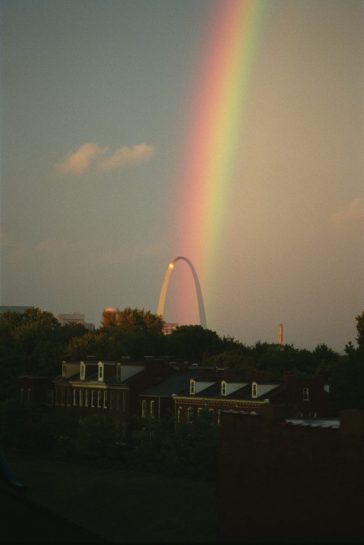
Photo credit: Scott Lokitz