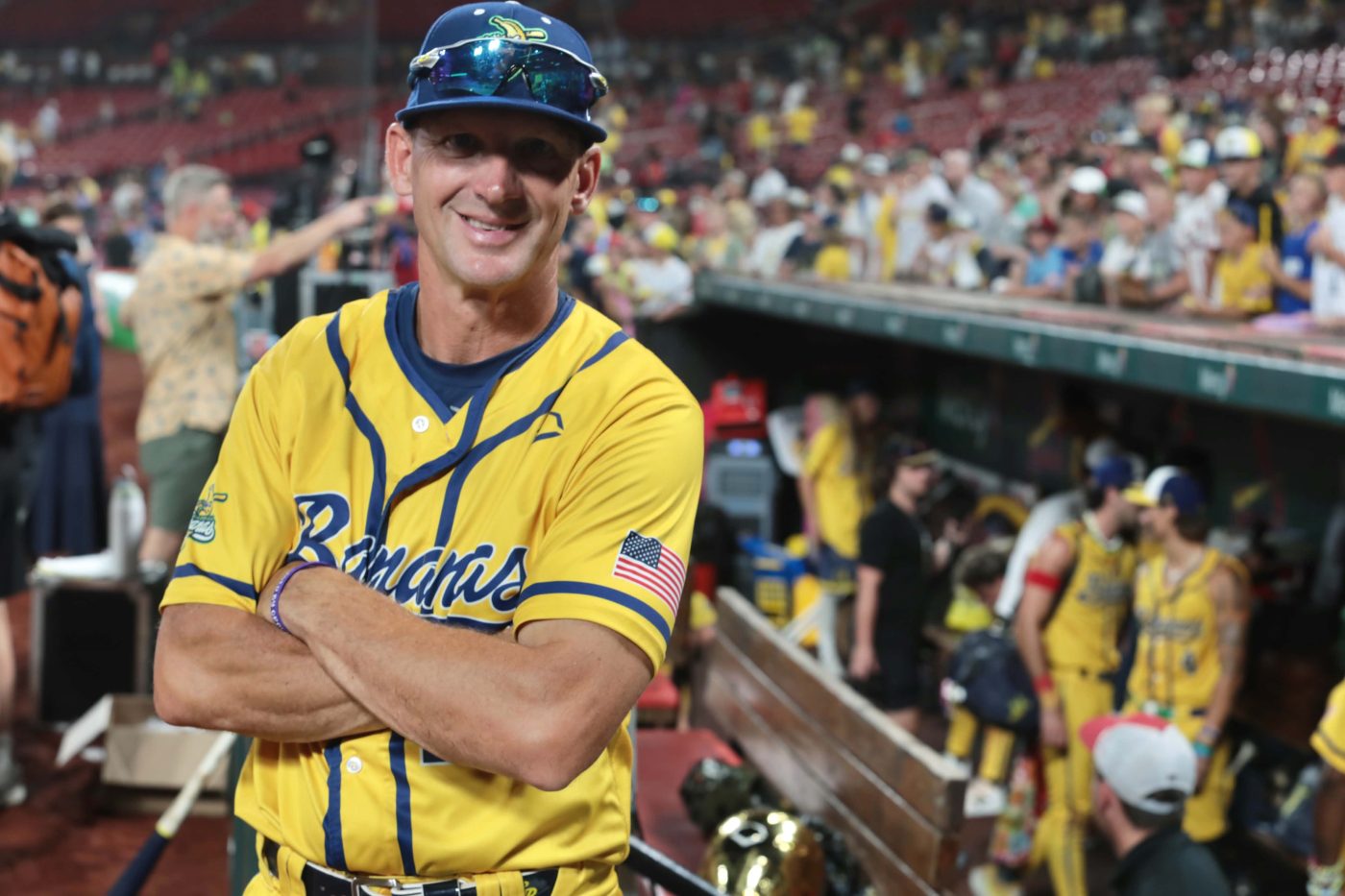
Banana Ball has transformed baseball into something faster, stranger and considerably more fun—and the Savannah Bananas have built a phenomenon around it. Ahead of their St. Louis appearance, we talked with head coach Tyler Gillium about bringing Banana Ball to Busch Stadium, the moments that go wildly off-script, and why the organization believes baseball can still surprise us.
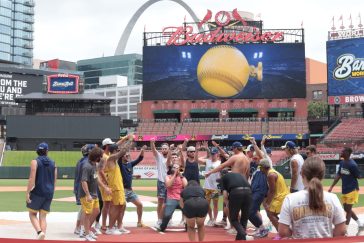
The Savanah Bananas Rehearsal. Photo credit: Thomas Blue
Q: You’ve played in some of the most iconic stadiums in America, but Busch Stadium has its own personality. What do you think happens when Banana Ball meets St. Louis baseball culture?
A: “What I love most about St. Louis fans is their baseball IQ. They know the game inside and out, which makes them the absolute best crowd for Banana Ball. When a guy squares up to bunt and the crowd collectively gasps because they remember bunts are illegal, or when the entire stadium erupts because a fan in the left-field bleachers catches a foul ball for an official out—that’s when the magic happens. They don’t just watch the chaos; they understand the strategy behind it.”
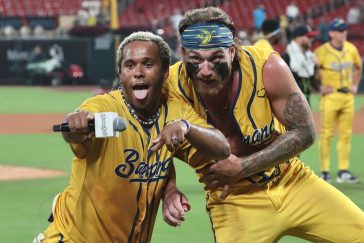
Ty Jackson & Dan Oberst. Photo credit: Thomas Blue
Q: Banana Ball was created to keep people from looking at their phones—but now your own social-media videos have millions of people watching them on their phones. Do you ever find the irony of that funny?
A: “Let’s be honest—most of what people look at on their phones these days is stressful, negative, or just boring. If someone is doom-scrolling at midnight and suddenly a video pops up of our pitcher throwing a strike on 10-foot stilts, or our team doing a fully choreographed Taylor Swift dance mid-inning, we just injected a little bit of fun into their day. If we are going to be on your phone, we want to be the best part of your screen time.”
Q: There’s a script for the entertainment, but there isn’t a script for what happens once the game gets crazy. What’s the funniest moment that completely went off-script?
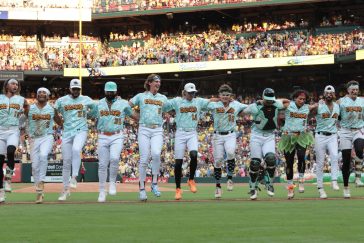
The Loco Beach Coconuts. Photo credit: Thomas Blue
A: “The absolute wildest unscripted variable is our foul-ball rule. If a fan catches a foul ball, the batter is out. One night, we were in a tight, high-stakes game against our rivals, the Party Animals. We had the go-ahead run on third base in the final inning. Our batter hit a screaming line drive into the stands. A fan holding a full box of popcorn in one hand and a baby in the other somehow deflected the ball, and another fan dove over a row of seats to catch it before it hit the ground.
“The stadium went so crazy that the umpire called the out, the inning ended, and I had to completely rewrite our pitching strategy on a napkin in the dugout because a fan just executed the best defensive play of the night. I went from drawing up a game-winning run strategy to trying to figure out how to stop the Party Animals from walking it off, all because of a guy in row 4.”
Q: At what point did you realize this wasn’t just a baseball team that people loved—it was becoming an entirely different form of entertainment?
A: “For the first few years, from 2016 to 2020, we were a traditional summer college team. We wore the yellow jerseys, did the dancing, and packed the stadium, but we still played regular nine-inning baseball. In the spring of 2021, we decided to do a two-city ‘Banana Ball’ test tour in Mobile, Alabama, and West Palm Beach, Florida. We wanted to see if people would actually buy into our new, crazy rulebook outside of Savannah.
“We rolled into Mobile, Alabama. We had no idea if anyone outside our hometown cared. When we arrived at the stadium, there was a line of thousands of people wrapped entirely around the block, hours before the gates even opened. People were dressed in full banana suits in 90-degree heat.
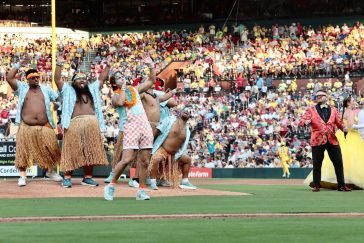
Photo credit: Thomas Blue
“The second the game started, the energy was different than anything I had felt in 15 years of coaching. We had the two-hour time limit clock ticking down, fans catching foul balls for outs, and non-stop music. When the game ended in under two hours and the entire stadium stayed for another hour just to sing and dance with our players in the parking lot, I looked at Jesse Cole and said, ‘The game of baseball has changed forever.’”
Q: The players aren’t simply athletes anymore—they’re performers, dancers, comedians and sometimes borderline stunt performers. What is the hardest part of the job that fans never see?
A: “The hardest part is making something that is incredibly difficult look completely effortless and fun. Our guys are world-class athletes and world-class entertainers, and balancing both is the hardest job in sports.”
Q: What’s something a new Banana Ball player has to learn that has absolutely nothing to do with baseball?
A: “The absolute hardest thing a new player has to learn is how to completely override their natural human survival instincts. In traditional baseball, your brain tells you to protect yourself. But in Banana Ball, we ask you to do things that make your college coach lose his mind.
“Look at JD Urso. JD came in as a great, fundamentally sound infielder. But we challenged him to learn how to catch a screaming groundball completely barehanded, between his legs, without a mitt. Do you know how much mental discipline it takes to let a baseball travel that deep into your personal space without putting a piece of leather in front of it? New guys have to learn to embrace the fear of getting hit, trust the rhythm of the bounce, and let the ball become a part of the performance.”
Q: What’s one Banana Ball rule you thought would be ridiculous when you invented it but turned out to be brilliant?
A: “In traditional baseball, a walk is the most unathletic, momentum-killing play in sports. The batter lazily jogs to first, the pitcher kicks the dirt, and the crowd goes to buy a hot dog. Jesse Cole said, ‘What if we turn a walk into a sprint?’
“When we wrote it down, it sounded completely fake. On Ball Four, the batter doesn’t walk—they take off sprinting. They can advance as many bases as they want, but here’s the catch: the ball is not live until every single defensive player on the field touches it except the pitcher and catcher. When we first read that out loud, we thought, ‘This is going to look like a chaotic playground recess, it’s too ridiculous.’ It turns out, nothing makes an outfielder run faster than the fear of a guy stealing third base on a walk.”
Q: If baseball is America’s pastime, what do you think Banana Ball is becoming?
A: “Look, ‘pastime’ is a beautiful word, but it implies looking backward. Traditional baseball relies heavily on nostalgia, history, and the way things used to be. Banana Ball is about the now. It’s fast, it’s vibrant, and it demands your attention every single second. We aren’t trying to replace the history of the game; we are trying to create an unforgettable, real-time core memory for a kid who might get bored sitting through a standard four-hour game. We are taking the best parts of the sport and making them immediate.”
Q: Banana Ball has created a culture where individuality and self-expression are celebrated. How intentional is the organization about making sure people—including LGBTQ+ fans and athletes—feel like they can show up exactly as they are?
A: “From a coach’s perspective, I tell our players all the time: ‘You cannot give joy to 40,000 people if you are holding back who you are on the inside.’ We don’t recruit cookie-cutter baseball players. We look for unique individuals with giant personalities.
“If a player thrives on high-energy dance routines, theater, or showing a softer, expressive side that traditional sports culture traditionally suppresses, we don’t just tolerate it—we design a mid-inning bit around it! We’ve built a locker room where athletes know they are safe, loved, and valued for their authentic selves. When an athlete feels completely secure in who they are, their performance on and off the field skyrockets.”
Q: This question was for Jesse, apparently he took the weekend off. So I’ll ask you—you’ve spent years telling people that baseball needed to be more fun. Now you’ve created something that’s arguably more recognizable than the baseball team you started with. At what point does the creator have to stop asking, ‘How do we make this bigger?’ and start asking, ‘How do we keep this from becoming something completely different from what we originally dreamed?’
A: “So to answer you directly: you stop asking ‘How do we make this bigger?’ the minute you realize that a bigger stadium doesn’t mean a better experience. We are shifting our focus from horizontal growth—adding more teams and more tours—to deep vertical growth.
“Instead of asking how to reach ten million more people on a phone screen, we are asking, ‘How do we make the two hours a family spends with us at the ballpark the absolute best two hours of their entire year?’ We don’t want to become an unrecognizable entertainment corporation. We want to stay a wild, passionate family on wheels that happened to save baseball by refusing to take themselves too seriously.”
Banana Ball may look like chaos, but behind the costumes, choreography and unconventional rules is a very deliberate attempt to make baseball feel immediate again. If Gillium is right, the real competition isn’t traditional baseball—it’s everything else competing for our attention.