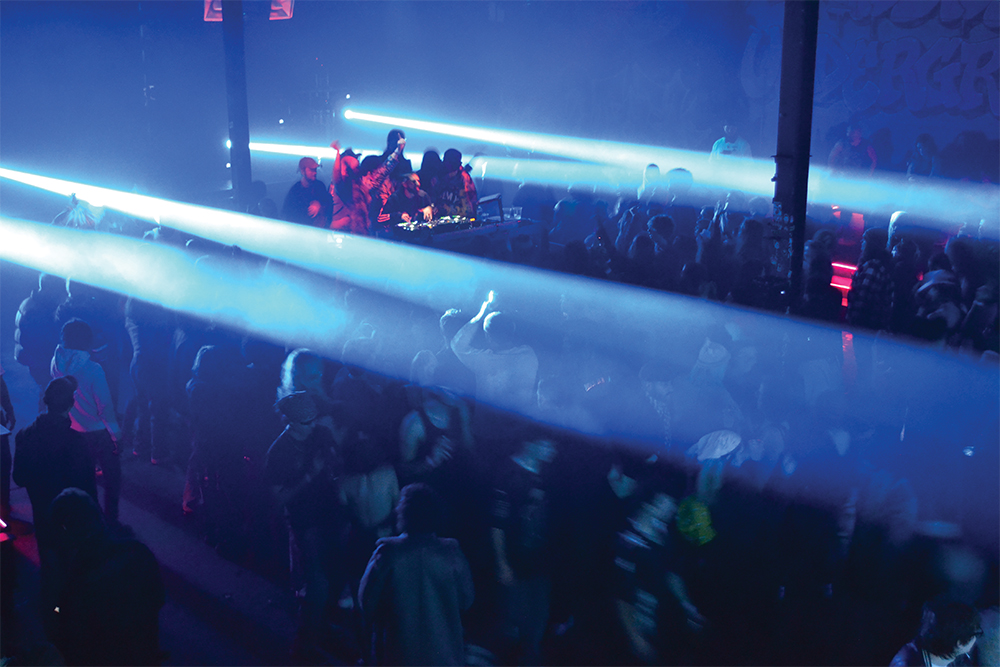
In downtown St. Louis a mile away from the Arch, nestled between abandoned warehouses on the North Riverfront District is a small black boarded-up building like any other, with graffiti lining its exterior and bricks falling out of place. But when the lights come on and the garage door opens, Mississippi Underground is revealed. This 10,000-square-foot former soap factory turned rave venue comes alive on the last Saturday of every month to host the hit rave collective Materia.
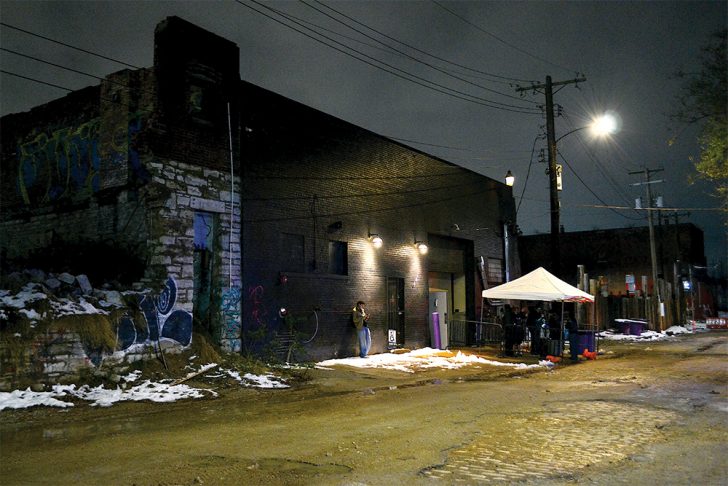
The unassuming exterior of Mississippi Underground. Photo credit: Charlie Blasingmae.
What started in 2021 as a group of DJs hosting underground raves out of friends’ basements has evolved into a defining facet of St. Louis nightlife, attracting up to a thousand ravers a night and ten thousand followers on Instagram. On November 29, 2025, Materia celebrated its fourth anniversary. “I think the goal was to throw a party that everyone, and I mean everyone, felt comfortable at,” says Alexandra Layton, the St. Louis-based DJ otherwise known as Manapool and one of the collective’s five founding members. “Queer people, especially black queer people, and also just regular-ass people that would go to clubs that look like anyone else. Maybe they do have spaces, but we wanted to show the general demographic of people what things can be like.”
Prior to Materia, the city’s rave scene had some crucial missing pieces. “There wasn’t a queer scene, there wasn’t really a black scene at the time,” Layton explains. “There was, but they would always die out really quick in St. Louis, and it just made me mad more than anything.” She exhales a cloud of smoke and passes a cigarette to co-founder Pajmon Porshahidy, known as Umami. They share space on a black leather sofa in the small green room; even as deep bass rhythmically rattles the walls, the voices of the crowd trickling in are audible from here.
The crew describes St. Louis nightlife before Materia as scattered pockets of events appealing to specific crowds, but nothing established or all-encompassing. Materia prides itself on not appealing to one specific community but rather a collective that unites people from disparate scenes together. Deep in the warehouse lost among the graffiti, pounding electronic music and neon lasers, you could find yourself dancing with an emo punk, a gray-haired biker or a college sophomore home for the weekend.
“I think that [inclusivity] comes from naturally just being ourselves,” says Porshahidy, who identifies as a nonbinary Iranian-American. “I’m a person of color who is a queer person who has been discriminated against during my life, Manapool is trans, we have two Black people on our team and one is extremely queer.”
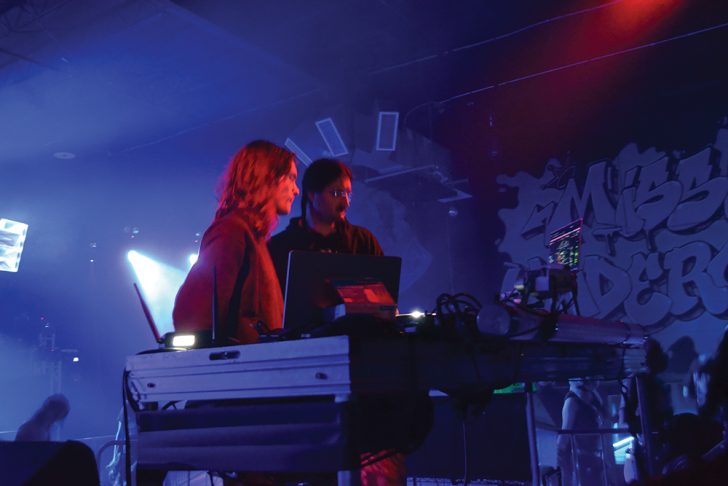
Manapool and Unami on the decks. Photo credit: Charlie Blasingame
The idea for Materia came a little over four years ago when Layton, who was a DJ in the screamo scene, met Nadir Smith, a St. Louis-based electronic DJ. “Me and Nadir really connected on the electronic music we liked, which there wasn’t a market for in St. Louis at all,” explains Layton. “I was getting booked all over the country, but I wasn’t really getting any attention here. And Nadir was in the same boat. We were both a little too experimental.”
Layton and Smith decided to host their own DIY house parties where they could cultivate a scene in which experimental music was celebrated and all kinds of people were welcome. As the concept for Materia began to solidify, Billy Samson, a musician from Webster Groves, was recruited by Porshahidy to handle production. Shortly thereafter, flamboyant rapper Eric Dontè joined the crew as their MC, making him Materia’s fifth and final member. Layton says Materia is meant to be a space that combines and amplifies the crowds that each different member has been performing for on their own. Layton and Smith were big in the screamo and emo revival while Porshahidy played in more stereotypical St. Louis clubs. “My club shows were very diverse,” says Porshahidy. “I would have people from the hood come and see me play and people from college and West County come see me play. They all mingled into one space.”
“I feel like all of us bring alternative music, but it’s also different and unique to us,” says Dontè. “And the type of crowds we bring out are completely different. So when we all linked up, it was just like — we got life. We all mesh so well. And that’s the same way it bleeds into the crowd, you know what I mean?”
Evidently, St. Louis was in dire need of inclusive nightlife, because Materia took off. As the events grew in popularity, the crew had to constantly find new venues that could accommodate the growing crowd. Early on, ravers would be packed into friends’ houses, dive bars like Sorority House, and even the basement of thrift store Found By The Pound. “Materia threw their first rave in November of 2021,” Porshahidy recalls. “There would be a hundred plus people crammed into a basement for like five dollars.”
“Our marketing was: if you know, you know,” adds Layton. “It’s the worst marketing — and somehow it worked.” It wasn’t until the end of 2022 that St. Louis raver Julian Jordan reached out to Materia to offer hosting them at the abandoned soap manufacturing warehouse he owned on North 2nd Street just off Cass Ave. It was a generous offer, but there was a huge amount of work to be done to get it into a usable state. The crew cracks up at the memory. “There was dust and trash everywhere!” Porshahidy laughs. They all poured their time and energy into renovating the warehouse, since dubbed Mississippi Underground Hall and which has now been completely renovated to include two bars, a lobby, the green room, and a dancefloor with a stage, video walls, projectors and geodomes.
“Materia 100% filled a void that queer ravers needed in St. Louis because it was just pockets, and we needed a big rave, and a place for all of us to come together,” says KC Mackey, a DJ and activist organizer who has performed at multiple Materia shows. She recalls moving to St. Louis from Boston, where she had been immersed in the underground rave scene. As a queer woman, Mackey struggled to find a fit in St. Louis nightlife. That is, until she stumbled across Materia. “I hadn’t felt that way ever in St. Louis, even though I had been to some really cool drum and bass nights and things like that,” she says. “Materia felt different.” She now makes sure to hit up every Materia event.
Mackey says Materia has been able to retain its underground aesthetic despite blowing up. “The vibe that I felt playing the tenth show was the same vibe I felt playing number 32, but on steroids,” she says. “I think number ten, I played for like 100 people and number 32, I played for a thousand.”
Keeping the show going has essentially become a full-time job for the Materia crew. They strive to maintain affordability and authenticity via a reliable earlybird ticket price of $20, and they keep production minimal to replicate their early DIY house shows.“Starting it out, we were working the door while DJing,” says Dontè. “Like, we ran shifts. It was just the five of us. We was the security, the door person, the this and that. And over four years now, we got, like, floor monitors, we got door people, bartenders, security. You know, we got everything.”
As their audience expands, so has their ambition. While they keep St. Louis DJs up in the mix, they’ve also flown in celebrated DJs from other scenes around the globe: Bianca Oblivion from LA, Paris’s DJ Emma. The artists rep an array of diverse styles — footwork, drum and bass, acid house, techno and a myriad of subgenres, Materia bangs it all. “We’re trying to put St. Louis on the map,” says Samson.
The crowd at tonight’s show, which also doubles as their fourth anniversary, echoes the same sentiments. Outside the main room ravers huddle in the cold, passing cigarettes and dancing to the still audible beats from inside. Nylah Jones, a college student and native St. Louisan, describes Materia as “on a different level” from elsewhere in the scene. “Having that diversity, I’ve seen so many types of people here,” says Jones. “They all come from different backgrounds and I think that’s really cool.” When asked if other St. Louis nightlife events compare, Jones and her friends furiously shake their heads.
Angie Bocos and Kaylee Garrison are here in full emo attire, decked out in towering platforms and bold eyeliner. Both say they’ve been attending Materia for a couple months now. “There are so many different people!” says Bocos happily. “It’s a lot more alternative than you would think. There’s a lot of people you might not normally see.” They dance near the DJ booth with their friends, each rocking their own fashion statements — one sports a fur raccoon hat, another an open denim jacket over bare skin. As the night deepens the floor fills more and more; by midnight it’s legitimately packed, a sea of limbs responding to every bass drop and every pulsing sine wave.
Having established their place in St. Louis, the Materia crew has hopes of expanding into surrounding Midwest cities, bringing the same queer-driven, genre-uniting underground ethos to places that desperately need it. “The thing I like about St. Louis the most, is it’s just so ready to soak up culture or make culture happen. I thought of Materia and what we were doing as a movement,” says Layton. “It’s like, when you live in the Midwest, you kind of have to latch on to whatever’s cool because you don’t get a lot of chances to experience cool shit.”
“We want people to leave thinking that was cool,” says Porshahidy, “and it was in St. Louis.”