There are concerts you attend, concerts you remember, and then there are concerts that make you wonder if you just witnessed something that could never quite be duplicated in a larger room.
September 14, 2026, at The Sovereign in St. Louis was one of those nights.
If you were fortunate enough to be inside the intimate venue that evening, you quickly realized that seeing an artist as fearless and unpredictable as Peaches in a room that small was something special. There was no enormous production swallowing the artist. No stadium-sized video wall. No distance between performer and audience.
There was Peaches—and there was the crowd.
Before Peaches ever stepped onto the stage, Wheelchair Sports Camp had already done its part, getting the crowd moving and raising the energy for what was coming. By the time Peaches appeared, the room was ready.
And then the construction began.
Peaches. Photo credit: Thomas Blue
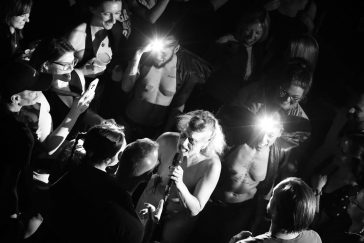
At first glance, the stage setup appeared almost deceptively simple. But as Peaches performed, her dancers began constructing and rearranging platforms around her. What looked like a straightforward stage gradually transformed in front of the audience. The movement, timing and placement created something that was almost an illusion. The performance kept changing without ever feeling disconnected.
It was simple.
It was cohesive.
And somehow, it kept getting bigger without the stage actually getting bigger.
Peaches incorporated material from her new album, No Lube So Rude, into a set that also reached across her catalog. But the real spectacle wasn’t simply which songs she performed. It was where she performed them.
At one point, Peaches moved from one side of the venue toward the other.
And then she did what Peaches does.
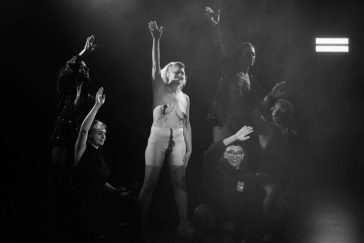
She went into the crowd.
Not to the edge of the crowd.
Into it.
Suddenly, the audience wasn’t watching a concert from a few feet away. They were standing virtually arm’s length from an artist who has spent decades turning performance, sexuality, gender and music into one giant act of creative expression.
For a few moments, Peaches wasn’t merely performing for the audience.
Peaches. Photo credit: Thomas Blue
She was performing with them.
After the show, I was able to catch up with Peaches for a few minutes and ask her how she felt about the St. Louis crowd.
Her answer was simple: “They were very spontaneous.”
There was certainly evidence of that.
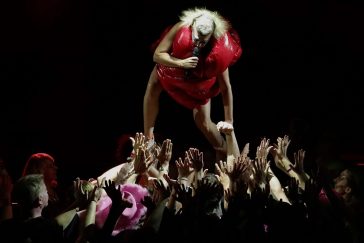
During the crowd-surfing portion of the evening, the audience seemed to figure things out as they went. Peaches had been moving toward the other side of the venue, but the crowd wasn’t necessarily sure where she was ultimately supposed to end up. They eventually guided her back toward the original stage, apparently unaware that another stage area existed farther back in the room.
It was one of those wonderfully imperfect concert moments where nobody quite has the map—but everybody is participating.
And perhaps that’s exactly what made the evening work.
Nearly 60 and Still Performing Without a Safety Net.
There’s something remarkable about watching Peaches perform at this point in her career.
She’s approaching 60, yet she performs with the physicality, confidence and sheer abandon of an artist decades younger. That’s not a criticism of younger performers; it’s an observation of stamina.
How many performers approaching 60 are willing to leave the stage, walk directly into a mixed crowd, dance beside their audience, scream their own lyrics and essentially turn the floor into their stage?
Peaches does.
And she does it without appearing to ask permission.
That’s part of the Peaches experience. The performance isn’t separated from the person. The audience isn’t simply looking at a stage. The boundaries keep disappearing.
For a community that has long understood the importance of artists who challenge expectations around gender, sexuality and self-expression, there is something particularly familiar about Peaches’ refusal to fit neatly inside anybody else’s definition of what a performer—or a woman—should look like at this stage of her career.
She doesn’t seem interested in aging into somebody else’s expectations.
She’s simply continuing to be Peaches.
There’s also something wonderfully old-school about the way Peaches has approached this North American tour.
Rather than arriving with an enormous traveling machine designed for arenas, the production has the feeling of an old-fashioned touring operation: a tour bus, a relatively small crew and a schedule that takes the show from venue to venue across North America.
That approach seemed particularly fitting at The Sovereign.
A larger venue might have provided more room, but it couldn’t necessarily have provided the same intimacy.
And intimacy became one of the defining words of the evening.
My own fascination with Peaches goes back to 2009, when I first saw her perform at Metro in Chicago. She would later appear at the iconic Smartbar. Some of the details of that night have faded with time, but I remember enough to know that Peaches has always had a way of creating an experience that doesn’t feel like a standard concert.
Peaches. Photo credit: Thomas Blue
September 14, 2026, gave me a new Peaches memory.
And this one is much clearer.
Because the performance at The Sovereign was simply spot on.
There was another surprise waiting at the end.
And Then Peaches Sang “People.”
If you knew Peaches primarily for the songs, attitude and provocative performances that have defined her catalog, you might not have expected the evening to conclude with “People,” the classic song from the 1964 Broadway musical Funny Girl, written by Jule Styne and Bob Merrill and famously introduced onstage by Barbra Streisand.
It was an almost surreal way to end a Peaches concert.
For anyone unfamiliar with her vocal abilities, the moment could easily have prompted the question: Is she singing over a track?
No.
She was singing it herself. And inside the acoustics of The Sovereign, the song became something more than an unexpected cover. It became a moment to appreciate music history—and to hear an artist known for confronting expectations suddenly embrace one of the great traditional vocal songs of the American stage.
It was unexpected.
It was beautiful.
And it was very Peaches.
Peaches has only a handful of North American dates remaining on the No Lube So Rude tour before returning to Germany, where she has lived for roughly two decades. Eventually, the tour will end and the lights will go down.
But September 14 in St. Louis will remain one of those nights where the size of the room actually became part of the story.
Because this wasn’t Peaches performing in spite of the venue’s size.
The size of the venue was exactly what made the experience so memorable.
And if Peaches starts appearing on your concert calendar in the near future, don’t just scroll past her name.
Go.
Because you may not get another opportunity to see an artist like Peaches this close, this fearless, this unpredictable—and this completely herself.