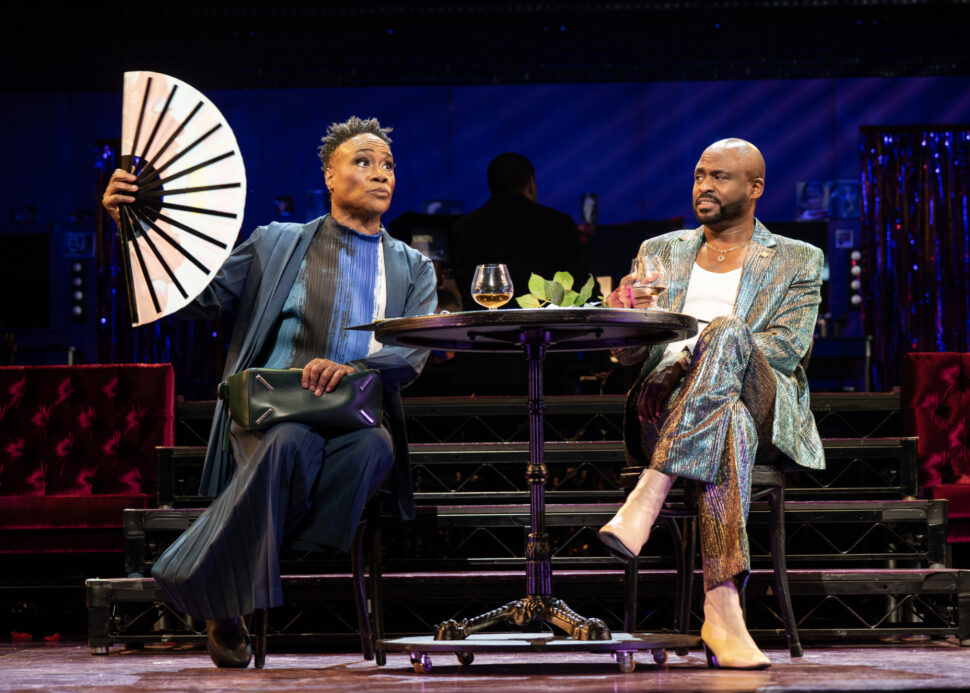
La Cage aux Folles. Book by Harvey Fierstein, based on the play by Jean Poiret. Music and lyrics by Jerry Herman. Directed by Robert O’Hara. Choreography by Edgar Godineaux, tap choreography by Dormeshia. At New York City Center. June 17-28, 2026. Approximately 2 hours 45 minutes, with one intermission.
La Cage aux Folles is a 1983 musical about love and acceptance wrapped in a warm French farce. The gay panic at its center is a couple who run a drag club on the French Riviera, forced to suppress who they are for one evening so their son can impress his fiancée’s conservative family, played as urgent provocation forty years ago. Today it is what it has always been underneath: a comedy with a real heart written to be palatable for a 1980’s Broadway audience. Robert O’Hara’s Encores! production with an all-Black cast, led by Billy Porter and Wayne Brady, brings something larger and more declarative to that material. The production is angrier than the show it’s staging. You feel that friction all evening.
Billy Porter plays Albin, the drag performer who headlines the nightclub act, and Wayne Brady plays Georges, his partner and the club’s proprietor. Porter and Brady have real chemistry. You believe these men have spent decades together. Brady commits fully: warm, grounded, funny at the right moments and quiet at the right ones. When Georges must reckon with what he has asked of the man he loves, Brady makes you feel the weight of it without working to show you. He is the evening’s clearest success.
The problem is that Porter’s voice, still recovering from the serious health issues he faced last year, could not fully meet the demands of Albin. The strain was audible and could not be ignored. His acting is as vivid as ever, and his stagecraft never wavers, but Albin is built around vocal grandeur, and the gap between intention and execution was a distraction the performance never 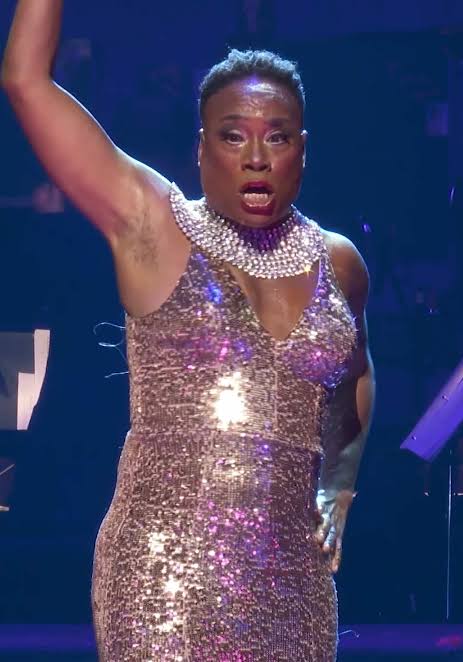 fully escaped. And yet something does come through, as much as the material allows: Albin as not only a gay man but an aging one, and the particular vulnerability that brings to a role whose glamour has always been a little desperate. It is the most interesting thing Porter finds in the character, and on the right night, in a fuller voice, it could be the most interesting thing anyone has found in it.
O’Hara’s most ambitious choice is the Cagelles. He reimagines the chorus line as iconic Black figures from history, among them Eartha Kitt as Catwoman and Beyoncé, and Edgar Godineaux’s choreography for them is aggressive and exhilarating. Much of the audience was delighted, and deservedly so. The creativity here is real. But it also concentrates the production’s central tension. The Cagelles exist, in the show’s original design, to create a unified, brilliant backdrop that frames and elevates the principals. Recreating them as distinct, recognizable personalities makes them stop functioning as a backdrop. They become a statement. The statement is made well. It costs the show something.
Adam Honoré’s lighting was the evening’s least defensible choice. A saturated purple wash held from nearly the first scene and rarely gave way, even in moments the show has always depended on lightness to make work. La Cage lives or dies on tonal contrast: the comedy needs air, the romantic scenes need warmth, and the title number should feel like a celebration erupting into full light. Here, everything flattened into the same moody register, and the effect was less Vegas glamour than Vegas at closing time. Staging at Encores! is constrained. Lighting at City Center is not, and keeping the palette this heavy throughout was a choice someone made. It was the wrong one.
What holds all of it together is Jerry Herman’s score. The original 1983 orchestrations, led by guest music director Joseph Joubert and the full Encores! Orchestra, had not been heard live since the show’s first Broadway run. Hearing them played by a full ensemble is genuinely moving. “Song on the Sand,” “I Am What I Am,” and the title number reminded you what the show was always best at: warmth.
The production swings hard for anger and declaration, and you admire every swing; what it can’t outrun is a show that was always better at warmth than argument. But at the end of the day, this a production worth seeing.
La Cage aux Folles played New York City Center (131 W. 55th Street, New York) June 17-28, 2026 as part of the Encores! series. Book by Harvey Fierstein, based on the play by Jean Poiret. Music and lyrics by Jerry Herman. Directed by Robert O’Hara. Choreography by Edgar Godineaux; tap choreography by Dormeshia. Scenic design: David Zinn. Costumes: Clint Ramos. Lighting: Adam Honoré. Sound: Megumi Katayama. Hair and wigs: Rob Pickens. Makeup: Joe Dulude II. Guest music director: Joseph Joubert.
© 2026 Adam Josephs. All rights reserved.