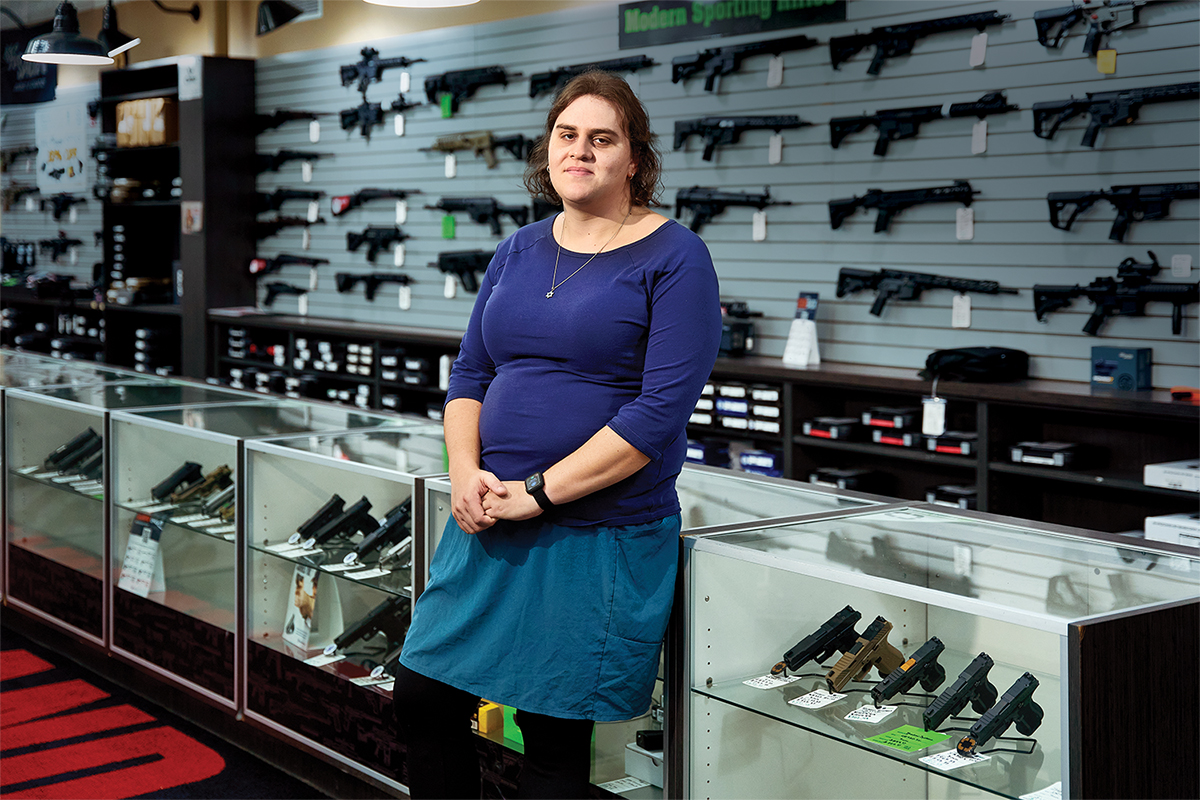
Whoever posted the flier didn’t want it going anywhere — duct tape on all four sides lashed it hard to a telephone pole. “St. Louis queer community: Do you feel scared and vulnerable being queer in these polarizing times? Then sign up for your concealed carry class, pistol class, or private lesson with Aria today.”
A growing contingent of LGBTQIA+ St. Louisans are arming themselves, many for the first time, because their trust in the government and the protection it offers them has evaporated in the face of a second Trump administration. And many are finding safety and solidarity in explicitly queer or queer-affirming spaces, like the training classes offered by the woman behind the flier: Aria Caligiuri.
Caligiuri, 29, has been running CCW permit classes since the late summer. The classes have two parts: a daylong, in-depth classroom portion covering laws, safety, storage and gun care; and then a shooting qualification at a range. Adults in Missouri can carry without a permit, but the credential lets them carry more places — and the class can help demystify weapons and make students feel safer and better informed. Once a student completes the class, Caligiuri signs off on their application and they’re eligible to apply for the permit. It’s not a slick operation; she’s running a cash-only business out of her apartment.
Those fliers, taped up on South Grand, Carondelet Park, the Central West End, and Wash U’s campus, went viral on Reddit, with hundreds of supportive posts from past students, queer folks and allies, and Second Amendment fans — unlikely bedfellows, perhaps. Caligiuri’s classes fill up quickly, and she’s been able to avoid financial peril despite having lost her job.
“I’ve taught a lot of queer people to shoot,” she says.
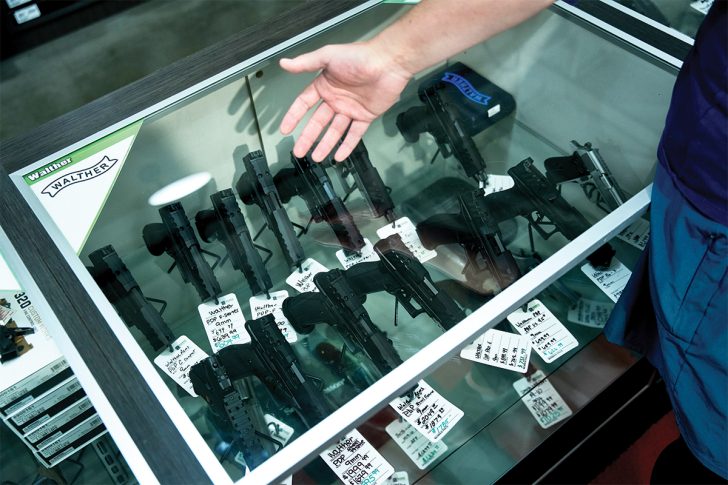
Handguns have offered some in the queer community a way to feel less anxious in an uncertain world. Photo by Theo Welling.
Caligiuri grew up around guns, learning to shoot in the Scouts at age 11 and keeping up the habit through college and beyond. She’s a National Rifle Association Certified Range Safety Officer Instructor and a Certified Pistol Instructor, authorized to sign off on city and county permit applications.
She says that while overall the environment for queer people has improved since she was a kid, her teaching is rooted in a desire to protect and empower her community at a time when the government can’t be relied upon to do so.
Her family was mostly secular, and Judaism, her mother’s faith, wasn’t more than nominally part of her life until college, which was when she also started to feel comfortable coming out as trans. Her undergraduate degree from UC Davis is in history with a minor in religious studies, and she earned a masters in Hebrew Letters and a Rabbinic Ordination from the Hebrew Union College – Jewish Institute of Religion in Los Angeles.
Prior to getting Training with Aria fully off the ground, Caligiuri had been working as a rabbi, most recently as a hospital chaplain. Long-term health troubles led her to leave that role. Chaplaincy isn’t exactly a lucrative line of work, so she’d already been teaching people to shoot on the side.
Her job loss and the political climate created the perfect timing for her to focus on instruction, so the fliers started going up in August. “It started as a side hustle,” Caligiuri says. “It’s a little bit better than a lemonade stand.”
The second Trump administration has come with open contempt for the LGBTQIA+ community starting on day one, with executive orders lashing out at gender-affirming care and trans people in the military, and declaring gender an immutable sex-based binary. The administration may have trans people’s Second Amendment rights in its sights next. “I heard the whole thing about Trump saying he wanted to get rid of transgender peoples’ guns,” says Caligiuri. “My reaction was a big sigh. Charlton Heston wouldn’t let anybody take his guns, and I take the same stance.”
On August 27, 2025, a 23-year-old trans woman murdered two children and wounded thirty other people before ending her own life in a mass shooting at Annunciation Catholic Church in Minneapolis. She was the fifth confirmed transgender mass shooter since January 2013, out of more than 5,700 mass shootings during that time, according to CNN reporting.
After the shooting, the United States Department of Justice reportedly began looking into ways to limit gun ownership for trans people. Mental illness can preclude the right to bear arms, and the proposed changes would use transgender identity as a disqualifying diagnosis.
It’s unclear just how realistic the threat is to trans people’s Second Amendment rights, but the possibility adds timeliness and urgency to Caligiuri’s mission, and to the community’s appetite for training. While the responses to Training With Aria have been overwhelmingly positive, she does hear criticisms.
“The thing I’ve heard a lot is ‘You’re just giving more people guns, you’re just going to increase the gun problem, you’re training people how to kill people,’” she says. “It’s a real misunderstanding of what I do. In general, if somebody takes a class with me, they’re much less likely to have accidental death or injury because of a gun.”
While she’s someone who happens to enjoy taking an AR-15 out and destroying a bunch of leftover Halloween pumpkins, she’s acutely aware that her clients likely have different perceptions of shooting. “Ninety percent of my clients are new gun owners,” she says.
That can come with fear and baggage. Her own trainer instilled in her to never be dismissive of students’ trauma with guns, and her teaching is specifically from a trauma-informed perspective. That might mean that students need to call a time out or handle the full-weight neon-colored rubber gun models she keeps on hand before they are willing to touch an actual gun.
“I once had to counsel a grandmother whose granddaughter had been shot to death as a hospital chaplain,” she says. “It gave me a very healthy respect for the damage that guns can do.”
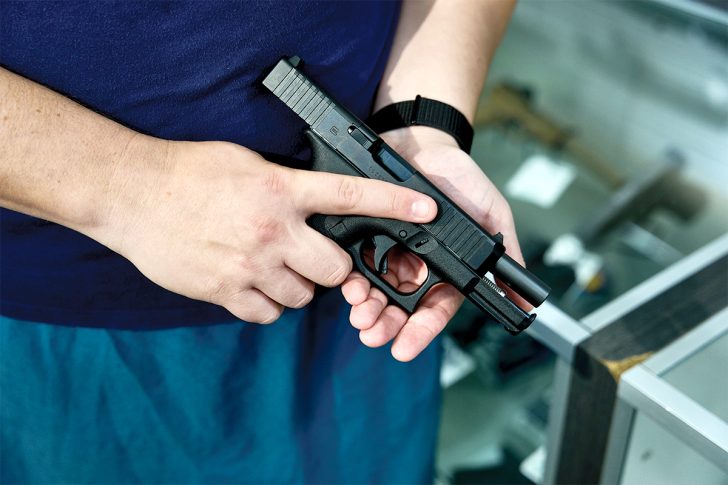
Safe handling is crucial. Photo by Theo Welling.
Caligiuri’s apartment features an American flag, a couple menorahs, an impressive variety of hot sauces, and a wall hanging with two dolphins forming a yin yang symbol. There’s a Lego cat and a Lego Mona Lisa. There are long guns, pistols, and fake rubber guns arrayed on a glittery pink tablecloth.
Seven students are sweltering on futons and camp chairs in a mid-October heatwave as Caligiuri walks them through the finer points of Missouri law on carrying guns. She shows a slide with three photos of herself in sporty, casual, and more formal attire. In the next slide, she’s revealing the pistols she’d concealed in all three looks. She carried at Pride. She’s carrying right now.
Caligiuri makes the de rigeur disclaimer that she’s not a lawyer, but so far she’s unstumpable on the finer points of the legality of owning grenade launchers, switchblades, and brass knuckles. She explains that it’s currently a class D felony to carry on public transit, but the Missouri legislature is working on that. She’s a scholar of the revised statutes of Missouri, but also a pragmatist.
“Don’t stir up drama, don’t be a bad representative of the Second Amendment,” she implores the class. “If someone sees your weapon and they ask you to leave, even if you know your permit is in order, the cool thing to do is leave.”
Lizz, 32, learned about the class on the Queer Exchange on Facebook. She’d been considering getting her permit to increase her earning capability as a licensed security officer. “With recent developments across the country, it has inspired me to accelerate the process,” she explains. ICE raids specifically have her concerned. “I have friends who are immigrants. Being a person of color in this country, maybe we should take this a bit more seriously.”
Jamie Hayes, 58, is a military veteran. She served in the Army for four years, and it’s given her lasting trauma around firearms. “I saw the damage they can do and swore off them,” she says. “I’m very much respectful of the damage they can do. I’ve seen it in person.”
She hasn’t decided if she is going to complete the permit application. But training seems like a step toward overcoming her trauma. Doing so in an explicitly queer environment, she says, is important. “There’s been a lot of online threats against trans people by people that are…not quite as hinged,” she says diplomatically.
Her roommate Jessica Lewis, 54, says that walking into a space full of weapons that’s not explicitly queer affirming seems almost insurmountable. From her standpoint, there’s no time like the present for learning about guns. “It just feels like with everything going on this world, when it hits the fan, it’s going to be too late to start taking classes.”
Caitlin McMurtry is an assistant professor and researcher at the Brown School at Washington University in St. Louis. She recently published “The Changing Politics of Guns in America” in the Journal of Health Politics, Policy and Law out of Duke University. She’s not surprised to hear that queer people are seeking out weapons training.
“We’ve really seen a change in the politics of guns in America that kind of preceded the pandemic, but then really co-occurred with the pandemic,” she says in an interview. “We’re starting to see the profile of gun owners change. Then I think it really amplified before and after the most recent presidential election.”
In her paper, McMurtry wrote that between 7.5 and 10 million people say they bought a gun for the first time since the start of 2020, with higher proportions of Democrats, women, and Black, Asian and Latin people reporting recent purchases.
Accurate and granular data on gun ownership in the United States has always been protected and hard to come by. And the current federal administration has cut grant funding and staff at places like the National Institutes of Health and the CDC, which study gun ownership. But it’s undisputed that U.S. gun ownership rates are the highest in the world by far. We have more guns than people — approximately 1.25 per resident — and CDC data says that nearly 47,000 people died of gun-related injuries in 2023.
“We know that the more firearms there are in society, the more likely that people are going to die, whether it’s by suicide, homicide, accidents or other types of interpersonal violence,” McMurtry says. New types of people, she found, are arming themselves because they don’t trust the government, and buying a gun can be a way to feel strong and self-sufficient. And that’s what needs to be studied, she says: Not just the types of guns people own and how they’re stored, but the societal conditions that lead to this mindset.
“I think we need to be stepping back and saying, okay, rising distrust across society is fueling an arms race that we are going to have a very difficult time getting on top of,” McMurtry says. “If we cannot understand why people are arming themselves, we are missing the whole point.”
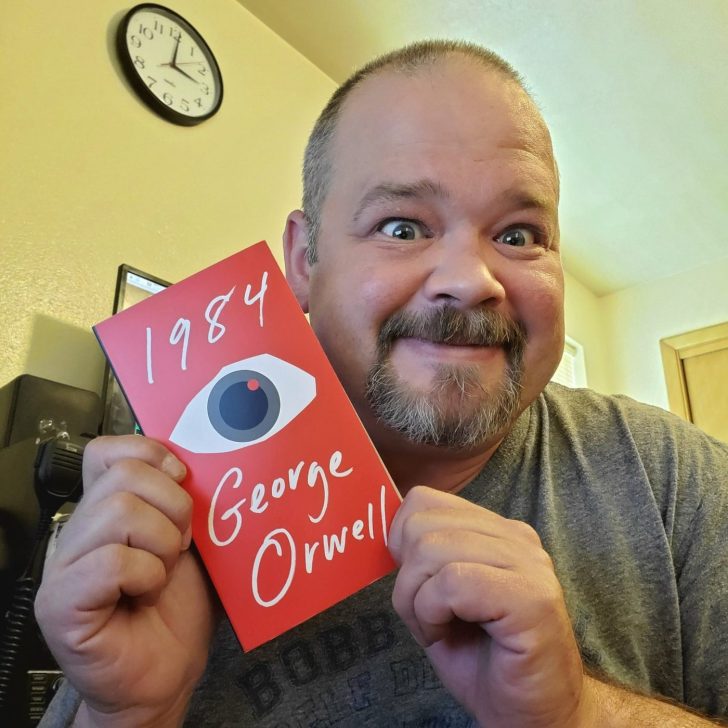
Andy Sims
Self-described “gun nut” Andy Sims, 52, has an idea. “You can’t trust the government to look after you,” he says. “I would like for homophobes and gay bashers’ default to be, ‘Well, all the queers are carrying guns now, maybe we should leave them alone.’”
Sims knows that he comes across as someone he’s not. He’s a cisgender single dad with a ton of guns, including a hot-pink AR-15 he made himself that always attracts attention at the range. He sometimes reads as straight, and maybe even MAGA adjacent — and neither of those are true. His gun nut status is known to all his friends and acquaintances, and he’s an admin of the STL Queer Gun Club page on Facebook.
There are keyboard warriors, he says, claiming homophobic opposition to queer gun ownership. He’s yet to meet anyone like that in the real world, though. “I think a lot of people in the Second Amendment space are getting better about shutting that down,” he says.
It’s a historically conservative demographic, but people there are finding themselves pushing back hard against the idea that anyone — trans people included — should be disarmed by the government. After Trump was reelected, Sim’s phone started ringing, he says, with calls from queer folks and liberals tentatively considering gun ownership. He’d hoped to do some teaching along the lines of what Caligiuri is doing, but health troubles kept him from getting underway. He’s just glad it’s getting done.
While McMurtry sees training as a worthwhile form of harm reduction, she says there are potential consequences that give her pause.
“If people feel like they’re well-trained, are they more likely to carry it loaded? Something that might otherwise be just a fistfight now becomes a shootout,” she says. “Everything is simplified if you have a gun, and also if you think the other person has a gun.”
McMurtry talks about external margins and internal margins as useful metrics for the conversation. For the external margin, think of a light switch: It’s binary, it’s either on or it’s off. But for the internal margin, think of a dimmer switch: the light can be made incrementally more or less bright.
The external margin on gun ownership is either having one or not having one and it tends to be inflexible. Once someone has a gun, they tend to remain in the gun-owner population, and people rarely get rid of them once obtained. The internal margins — habits like storage, safety practices, and carrying — are where McMurtry sees ways to get ahead of the “arms race” she mentioned and save lives. Queer people have higher rates of depression, and McMurtry says people in the community should have plans for getting their own guns out of their homes when things get bad, or a protocol for holding on to loved ones’ weapons when they’re struggling.
“We don’t have a good schema for how to do that in this society, right?” she says. “But part of being queer is having to blaze those trails. And if we can figure out how to do it well in our own communities, we can also be an example for others about how to have really difficult, honest conversations about how we take care of each other.”
Sims says that a lot of the reason people buy firearms is fear. His own father bought his first handgun in response to a murder in their rural community. He says about half the people he’s heard from are “extremely liberal people, like English teachers and stuff,” who are embarrassed or ashamed to be considering owning weapons because their political party has been in favor of gun control for so long.
“I think they’re waking up,” he says. “They’re starting to realize nobody’s coming to save them. Really when it boils down to it, you are on your own.”
That mindset, McMurtry says, is where the work is. “I think this is very legitimate fear about violence, for example, against trans people in society, or the risk of calling the police if you are Black in America,” says McMurtry. “But I think we have some societal work do on that fear. We have a lot of work to do as a society to make trans people feel safer, like they don’t need to carry a gun.”
Caligiuri, for one, thinks that might be a nice idea, but not a realistic one. “We’re far past that point,” she says. “Can we prevent every tragedy? No. We focus on the tragedies we can prevent. We start with educating the people who want to be educated. I’m doing that for the queer community.”

